
Disclosure: As an Amazon Associate, Bookish Wisdom earns from qualifying purchases. This doesn't change our picks or your price.
TL;DR: Guy Montag is a fireman whose job is to burn books in a future America obsessed with television. After meeting a curious young neighbor and seeing a woman die with her books, he begins to read and question everything. He escapes to a group of outsiders who memorize books to save them.
Table of Contents
Fahrenheit 451 at a Glance
| Author | Ray Bradbury |
| First published | 1953 |
| Type | Dystopian novel |
| Best for | readers who want a short, poetic warning about censorship and distraction |
Fahrenheit 451 is a dystopian novel by Ray Bradbury, first published in 1953. It imagines a society where people have chosen screens, speed and noise over books, and where firemen start fires instead of putting them out. Below you will find a part-by-part summary, five key takeaways, ideas worth remembering and a note on who will enjoy it.
What Happens, Part by Part (Contains Spoilers)
The Hearth and the Salamander
Montag enjoys burning books until he meets seventeen-year-old Clarisse McClellan, who asks him whether he is happy. He realizes he is not. At home, his wife Mildred has overdosed on sleeping pills and spends her days with giant TV “parlor walls”. On a call, a woman chooses to burn with her books rather than leave them, and Montag secretly takes a book.
Questions and Beatty
Clarisse disappears, and Montag stays home sick. His fire captain, Beatty, visits and explains how books were banned: people wanted shorter, simpler entertainment, and books made them unhappy by raising hard questions. Montag reveals to Mildred that he has hidden a stash of books, and they try to read together.
The Sieve and the Sand
Montag seeks help from Faber, a retired English professor. Faber gives him an earpiece so they can talk secretly. Montag reads poetry aloud to Mildred's friends, upsetting them, and Mildred reports him. Beatty taunts Montag with quotes about books, showing he is a reader himself who chose to enforce the rules.
Burning Bright
The firemen are called to Montag's own house. Beatty forces Montag to burn it, then threatens him, and Montag turns the flamethrower on Beatty. He flees as a mechanical Hound hunts him, crossing a river to escape the city while the chase is broadcast on television.
The ending
Montag finds a group of exiles led by Granger, each of whom has memorized a book so it can be passed on. As they watch, war destroys the city. The group plans to return and help rebuild, carrying their books in their memories. Montag, who has tried to memorize a book himself, is ready to help keep the stories alive.
5 Key Takeaways
- Censorship often begins with people choosing comfort over difficult ideas.
- Constant entertainment can leave people lonely and empty.
- Curiosity and asking questions can wake people up.
- Books preserve memory, history and different ways of thinking.
- Even one person can resist a system by reading and remembering.
Ideas Worth Remembering
These are paraphrased, not direct quotes:
- It is not the books themselves, but what is in them, that matters.
- A question can be the start of a rebellion.
- People can lose freedom by not caring enough to use it.
Who Should Read Fahrenheit 451?
Read Fahrenheit 451 if you love books or worry about how screens shape our lives. It is short and often taught to students about 13 and up.
Questions to Think About After Reading
These prompts work for solo reading, a book club or a classroom discussion of Fahrenheit 451:
- Why do you think people in Montag's world stopped reading?
- What role does Clarisse play in changing Montag?
- Which of Bradbury's predictions feel closest to today?
How to Use This Summary
Use this page as a quick reference before a book club meeting, an exam, or a decision about whether Fahrenheit 451 is worth your time. The takeaways are written to stand on their own. If a point interests you, go back to the book for the author's full story, characters and style, which no short summary can replace.
A Note on Accuracy and Spoilers
This summary is based on the published text of Fahrenheit 451, not on any film, series or stage adaptation, which often change the story. Details are kept at the level of the main events so that nothing is invented. Editions differ slightly in length and wording, so page numbers and small details may vary between copies.
Should You Read the Book?
If the summary caught your interest, read the opening chapters before you decide. A summary tells you what happens, but the voice and pacing are what make a book work or not.
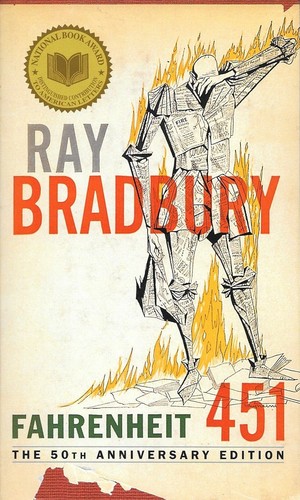
Check price of Fahrenheit 451 on Amazon
What to Read Next
- 1984 by George Orwell: a classic dystopia about surveillance
- Brave New World by Aldous Huxley: a dystopia of pleasure and control
- The Book Thief by Markus Zusak: a girl who steals books in Nazi Germany
Related: Something Wicked This Way Comes by Ray Bradbury: Summary and Key Takeaways
Frequently Asked Questions
What is Fahrenheit 451 about?
A fireman who burns books begins reading and rebels against a censoring society.
What does the title mean?
Bradbury describes 451°F as the temperature at which book paper burns.
Who is Clarisse?
A curious young neighbor who makes Montag question his life.
Who is Beatty?
Montag's fire captain, who knows books well but enforces the ban.
What happens to Mildred?
She reports Montag and leaves him.
How does it end?
Montag joins exiles who memorize books, and they plan to rebuild after a war.
What is the Mechanical Hound?
A robotic hunting machine that tracks and kills people who break the law.
Is Fahrenheit 451 hard to read?
No. It is short, though its poetic style takes some getting used to.
Is Fahrenheit 451 worth reading?
It depends on what you want. The book is best for readers who want a short, poetic warning about censorship and distraction. If that describes you, it is likely a good fit. If not, the titles under What to Read Next may suit you better.