
Disclosure: As an Amazon Associate, Bookish Wisdom earns from qualifying purchases. This doesn’t change our picks or your price.
TL;DR: Freakonomics uses economic thinking and data to answer surprising questions, from why drug dealers live with their mothers to whether baby names affect success. Its big lessons: incentives drive behavior, conventional wisdom is often wrong, and asking the right questions of data can reveal hidden truths about everyday life.
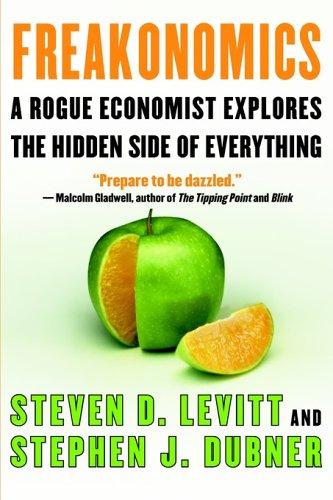
Published in 2005, Freakonomics: A Rogue Economist Explores the Hidden Side of Everything was a surprise bestseller that launched a podcast, sequels and a documentary. Economist Steven D. Levitt supplied the research; journalist Stephen J. Dubner turned it into lively stories. The book famously has no unifying theme. Instead, it shows how a curious, data-driven mindset can be applied to almost anything.
Table of Contents
Freakonomics at a Glance
| Detail | Info |
|---|---|
| Authors | Steven D. Levitt and Stephen J. Dubner |
| Published | 2005 (revised and expanded edition 2006) |
| Genre | Popular economics / nonfiction |
| Structure | Six main chapters, each built around an unusual question |
| Best for | Curious readers, students and anyone who likes counterintuitive ideas |
What Is Freakonomics About?
At its core, Freakonomics is about incentives: the economic, social and moral reasons people do what they do. Levitt looks for natural experiments in messy real-world data to see how people actually behave, rather than how they say they behave.
Key Ideas, Chapter by Chapter
Incentives and Cheating
The first chapter compares schoolteachers and sumo wrestlers. Levitt shows how high-stakes testing in Chicago gave some teachers incentives to alter students’ answers, and how data hinted that some sumo wrestlers helped each other in key matches. A famous example: when Israeli day-care centers introduced a small fine for late pickups, late pickups increased, because the fine replaced guilt with a price.
Information Is Power
Comparing the Ku Klux Klan with real-estate agents, the authors show how experts can exploit information gaps. One finding: real-estate agents tended to keep their own homes on the market longer and sell them for more than clients’ homes, since a small price increase meant little extra commission for the agent but a lot for the owner.
Why Do Drug Dealers Still Live With Their Moms?
Using financial records from a Chicago gang, gathered by sociologist Sudhir Venkatesh, the book shows that most street-level dealers earned very little. Like many glamorous industries, the drug trade worked as a tournament where a few at the top earned a lot and most earned less than minimum wage.
Where Have All the Criminals Gone?
The most controversial chapter argues that the legalization of abortion in the 1970s contributed to the crime drop of the 1990s, alongside factors like more police and more prisons. Levitt also argues that some popular explanations, like the strong economy, played a smaller role than people assumed.
What Makes a Perfect Parent?
Analyzing data on children’s test scores, the authors suggest that who parents are (their education and circumstances) correlates more with outcomes than many specific things parents do, like museum visits. They also discuss how parents often fear rare risks more than common ones.
Would a Name by Any Other Name Smell as Sweet?
Studying California birth data, the book finds that names often reflect parents’ background and expectations, and that a name itself doesn’t appear to determine a child’s success. It also traces how names move from high-income to lower-income families over time.
5 Key Takeaways From Freakonomics
- Incentives drive behavior. Economic, social and moral incentives explain much of what people do.
- Conventional wisdom is often wrong. Popular explanations deserve skepticism.
- Experts can exploit information gaps. Ask whose interests an expert serves.
- Correlation isn’t causation. Careful data analysis is needed to find real causes.
- Ask unusual questions. Curiosity can reveal hidden patterns in ordinary life.
Ideas Worth Remembering
- Incentives are the cornerstone of modern life. (paraphrased)
- If morality is how we’d like the world to work, economics shows how it actually works. (paraphrased)
- Dramatic effects often have subtle, distant causes. (paraphrased)
What Do Critics Say?
The abortion and crime argument drew heavy criticism, and other economists challenged parts of the analysis, including a programming error in one of the underlying studies that Levitt acknowledged. Some critics also felt the book’s lack of a central theme made it feel like a collection of clever anecdotes. Still, it’s widely credited with making economics fun for general readers.
Who Should Read Freakonomics?
It’s perfect for curious readers, high school and college students, and anyone who enjoys podcasts and counterintuitive thinking. It’s quick, entertaining and requires no background in economics.
What to Read Next
- SuperFreakonomics by Levitt and Dubner, the sequel.
- Predictably Irrational by Dan Ariely on the hidden forces behind decisions.
- Thinking, Fast and Slow by Daniel Kahneman on how we really think.
Related: best books on logic and critical thinking and top 10 best-selling business books.
Frequently Asked Questions
What is the main idea of Freakonomics?
The main idea is that incentives drive human behavior and that careful data analysis can reveal surprising truths that conventional wisdom misses.
What is the most controversial idea in Freakonomics?
The most controversial idea is the argument that legalized abortion contributed to the drop in US crime in the 1990s. Other researchers challenged the analysis, and the debate continues.
Is Freakonomics still worth reading?
Yes. Some data is dated, but its way of thinking about incentives and questioning assumptions remains valuable and very readable.