
Disclosure: As an Amazon Associate, Bookish Wisdom earns from qualifying purchases. This doesn’t change our picks or your price.
TL;DR: In Predictably Irrational, behavioral economist Dan Ariely shows that people don’t make decisions like the rational calculators of classic economics. We’re swayed by comparisons, anchors, the word free, social norms, emotions and expectations. The good news: because these mistakes are predictable, we can design around them.
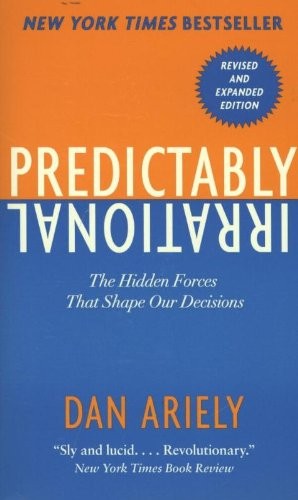
Published in 2008 and expanded in 2009, Predictably Irrational: The Hidden Forces That Shape Our Decisions helped bring behavioral economics to a mass audience. Ariely, a professor at Duke University, built the book around clever experiments, many run with students at MIT and Duke. Each chapter tackles a different way our minds systematically go wrong.
Table of Contents
Predictably Irrational at a Glance
| Detail | Info |
|---|---|
| Author | Dan Ariely |
| Published | 2008 (revised and expanded 2009) |
| Genre | Behavioral economics / psychology |
| Structure | Chapters built around experiments on specific decision biases |
| Best for | Marketers, students, shoppers and anyone curious about decision-making |
What Is Predictably Irrational About?
Traditional economics assumes people weigh costs and benefits logically. Ariely argues that our irrational choices aren’t random. They follow consistent patterns, which means businesses can exploit them, and we can learn to spot them.
Key Ideas From Predictably Irrational
Everything Is Relative
We judge options by comparison. Ariely describes a magazine offer with three choices: web-only, print-only and print-plus-web at the same price as print-only. The obviously worse print-only option, a decoy, pushed many more people to choose the bundle.
Anchoring and Arbitrary Coherence
First prices we see become anchors. In one experiment, students wrote down the last two digits of their social security numbers before bidding on items; those with higher numbers bid noticeably more.
The Cost of Zero
Free has a special pull. When chocolates were priced at a few cents, people chose the premium option, but when the cheaper chocolate became free, demand shifted dramatically toward it, even though the price difference between the two stayed the same.
Social Norms vs. Market Norms
We live in two worlds: one governed by friendly social norms and one by money. Mixing them can backfire. Offering payment for a favor can make people less willing to help, and once social norms are replaced by market norms, they’re hard to restore.
The Influence of Arousal
People predict their behavior poorly when they’re calm. In emotional or aroused states, they make choices they’d have rejected in a cool moment.
Procrastination and Self-Control
In a classroom experiment, students who had evenly spaced, imposed deadlines performed better than those who could set their own or submit everything at the end, showing the value of precommitment.
The High Price of Ownership
We overvalue what we own. Duke students who won basketball tickets in a lottery demanded far more to sell them than non-winners were willing to pay.
Keeping Doors Open
We waste effort trying to keep options available, even when doing so costs us. Committing to fewer paths often leads to better results.
Expectations and the Power of Price
Expectations change experiences. In one study, people reported more pain relief from a placebo pill when told it was expensive than when told it was discounted.
Honesty
Ariely’s experiments suggest many people cheat a little when given the chance, but reminders of ethical standards, such as signing an honor code, can reduce cheating. Cheating also rose when the reward was one step removed from cash, such as tokens.
5 Key Takeaways From Predictably Irrational
- Watch the comparisons. Decoys and anchors shape what seems like a good deal.
- Be wary of free. Zero price can lead you to choose poorly.
- Don’t mix money and relationships carelessly. Market norms can crowd out goodwill.
- Precommit. Deadlines and rules protect you from future temptation.
- Expectations shape experience. What you believe about something changes how it feels.
Ideas Worth Remembering
- Our irrational behaviors are neither random nor senseless; they are systematic. (paraphrased)
- We rarely choose in absolute terms; we compare. (paraphrased)
- The first price we see shapes what we’ll pay for years. (paraphrased)
What Do Critics Say?
Behavioral science has faced a replication crisis, and some findings described in popular books have not held up in later studies. In 2021, a separate 2012 study on dishonesty that Ariely co-authored was retracted after problems were found in its data. That study isn’t one of this book’s central experiments, but many readers now approach his findings with extra caution and look for independent confirmation.
Who Should Read Predictably Irrational?
It’s an engaging introduction for marketers, product designers, students of psychology or economics, and anyone who wants to make smarter money decisions. It pairs well with more rigorous texts like Kahneman’s.
What to Read Next
- Thinking, Fast and Slow by Daniel Kahneman for the research foundations of behavioral economics.
- Nudge by Richard H. Thaler and Cass R. Sunstein on designing better choices.
- Influence by Robert Cialdini on the psychology of persuasion.
Related: Freakonomics summary and best books on logic and critical thinking.
Frequently Asked Questions
What is the main idea of Predictably Irrational?
The main idea is that people make irrational decisions in consistent, predictable ways, influenced by comparisons, anchors, free offers, social norms, emotions and expectations.
What is the decoy effect?
The decoy effect happens when adding a clearly inferior option makes a similar, better option look more attractive, steering people toward the choice the seller prefers.
Is Predictably Irrational still reliable?
Many of its ideas, like anchoring and the pull of free, are well supported. But behavioral science has had replication problems, so it’s wise to treat individual experiments as illustrations rather than final proof.