

Disclosure: As an Amazon Associate, Bookish Wisdom earns from qualifying purchases. This doesn’t change our picks or your price.
TL;DR: In Made to Stick, brothers Chip and Dan Heath explain why some ideas are remembered and others vanish. Sticky ideas share six traits, summed up as SUCCESs: Simple, Unexpected, Concrete, Credible, Emotional and Stories. The biggest obstacle is the curse of knowledge: once you know something, it’s hard to imagine not knowing it.
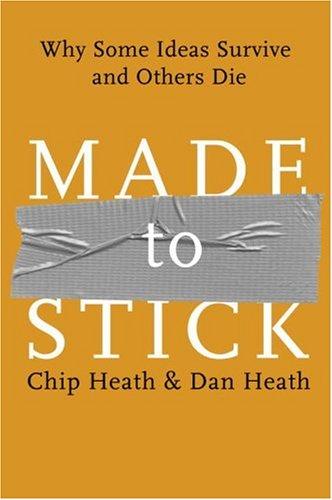
Published in 2007, Made to Stick: Why Some Ideas Survive and Others Die became a go-to guide for teachers, marketers, leaders and writers. Chip Heath is a Stanford professor who studied why urban legends spread; Dan Heath worked in education. Together they asked a practical question: how can good ideas be made as memorable as false rumors?
Table of Contents
Made to Stick at a Glance
| Detail | Info |
|---|---|
| Authors | Chip Heath and Dan Heath |
| Published | 2007 |
| Genre | Communication / business / psychology |
| Structure | An introduction plus one chapter for each of the six SUCCESs principles |
| Best for | Teachers, marketers, managers, speakers and writers |
What Is Made to Stick About?
The authors open with a well-known urban legend about a traveler who wakes up in a bathtub of ice missing a kidney. It’s detailed, surprising and frightening, and people remember it after hearing it once. Meanwhile, important messages like company strategies often vanish immediately. The difference isn’t luck. Sticky ideas share identifiable traits.
The Villain: The Curse of Knowledge
In a Stanford experiment by Elizabeth Newton, people tapped out the rhythm of well-known songs while listeners tried to guess them. Tappers predicted listeners would guess about half the songs; listeners got only a tiny fraction right. Tappers could hear the melody in their heads; listeners heard only knocking. Experts face the same problem when explaining ideas.
The Six Principles of SUCCESs
1. Simple
Find the core of your idea and strip away everything else. The authors cite the military’s concept of commander’s intent: a short statement of the goal that guides decisions when plans fall apart. Simple doesn’t mean dumbed down; it means focused.
2. Unexpected
Break people’s patterns to grab attention, then create curiosity gaps to hold it. Surprise gets attention; interest keeps it. A flight-safety announcement delivered with humor is remembered precisely because it’s unexpected.
3. Concrete
Use sensory language and real examples rather than abstractions. Concrete ideas are easier to understand and remember. The fable of the fox and the sour grapes has lasted thousands of years because it’s vivid and specific.
4. Credible
Help people believe your idea. Authority helps, but so do vivid details, statistics made human-scale and testable claims that let people check for themselves. The Heaths describe how a nonprofit made movie-theater popcorn’s fat content memorable by comparing one bag to a full day of greasy meals.
5. Emotional
Make people care. Research shows people donate more to help one identifiable person than in response to statistics about millions. Appeal to self-interest and identity, not just facts.
6. Stories
Stories work like mental flight simulators, letting people rehearse situations. The authors describe challenge plots, connection plots and creativity plots as three reliable story types, and they encourage spotting good stories rather than inventing them.
5 Key Takeaways From Made to Stick
- Beware the curse of knowledge. Explain as if to someone who knows nothing.
- Find the core. One clear message beats ten competing ones.
- Surprise, then satisfy. Break expectations and open curiosity gaps.
- Make it concrete and credible. Vivid details and testable claims build belief.
- Tell stories that inspire action. Stories help people remember and act.
Ideas Worth Remembering
- Once we know something, we find it hard to imagine not knowing it. (paraphrased)
- If you say three things, you say nothing. (paraphrased)
- Stories are simulations that prepare us to act. (paraphrased)
Who Should Read Made to Stick?
It’s valuable for anyone who communicates for a living: teachers planning lessons, managers sharing strategy, marketers crafting campaigns and parents explaining rules. It’s also a fun read packed with memorable examples.
What to Read Next
- The Power of Moments by Chip Heath and Dan Heath on creating memorable experiences.
- Switch by Chip Heath and Dan Heath on how to change things when change is hard.
- Contagious by Jonah Berger on why things catch on.
Related: best books on the art of storytelling and Predictably Irrational summary.
Frequently Asked Questions
What does SUCCESs stand for in Made to Stick?
SUCCESs stands for Simple, Unexpected, Concrete, Credible, Emotional and Stories, the six traits that make ideas memorable.
What is the curse of knowledge?
The curse of knowledge is the difficulty experts have imagining what it’s like not to know something, which makes them explain ideas in abstract, confusing ways.
Who should read Made to Stick?
Teachers, marketers, managers, speakers, writers and anyone who wants their ideas to be understood and remembered.