
Disclosure: As an Amazon Associate, Bookish Wisdom earns from qualifying purchases. This doesn't change our picks or your price.
TL;DR: During the Vietnam War, a young soldier named Cacciato walks away from his unit, saying he will walk all the way to Paris. On a long night on guard duty, Specialist Paul Berlin imagines the squad following Cacciato across Asia and Europe, a fantastic journey that mixes with his real memories of the war's deaths and fear.
Table of Contents
Going After Cacciato at a Glance
| Author | Tim O'Brien |
| First published | 1978 |
| Type | Novel |
| Best for | readers who want an inventive, dreamlike war novel |
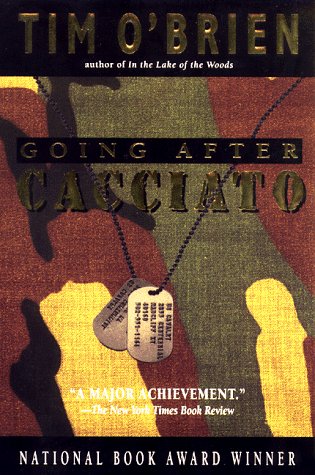
Going After Cacciato is a novel by Tim O'Brien, published in 1978. It won the National Book Award. Below you will find a part-by-part summary, five key takeaways, ideas worth remembering and a note on who will enjoy it.
Content note: Includes war violence and death.
Main Characters
- Paul Berlin: A young soldier and the main point of view.
- Cacciato: A strange, simple soldier who deserts.
- Lieutenant Corson: The squad's tired, sick leader.
- Sarkin Aung Wan: A Vietnamese girl in Paul's imagined journey.
- Stink Harris: A nervous, aggressive soldier.
What Happens, Part by Part (Contains Spoilers)
The desertion
Cacciato, an odd, childlike soldier, walks away from the squad, announcing he is going to Paris, 8,600 miles away. The squad follows to bring him back.
Three layers
The novel has three threads: Paul's real memories of the war, his thoughts during one night on watch in an observation post, and the imagined journey after Cacciato, which grows more fantastic.
The real war
Paul remembers the deaths of his friends: Billy Boy Watkins, who died of fright after a land mine; Frenchie Tucker and Bernie Lynn, who died searching tunnels; and others. He also remembers the squad's role in killing Lieutenant Sidney Martin, who ordered them into tunnels.
The imagined journey
In Paul's imagination, the squad travels through Laos, India, Iran, Greece and Germany. Paul falls in love with Sarkin Aung Wan, a refugee girl. They fall through a hole into a maze of tunnels, are arrested in Tehran and escape.
Paris
The imagined journey reaches Paris. Sarkin urges Paul to desert and stay, but he chooses to stay loyal to his unit. Back in reality, it seems the squad chased Cacciato onto a hill, and Paul panicked and fired his rifle. Cacciato's fate is left unclear.
5 Key Takeaways
- Imagination can help people cope with trauma.
- Fear shapes soldiers' choices.
- Duty and desire can conflict.
- War blurs reality and fantasy.
- Courage includes facing fear honestly.
Ideas Worth Remembering
These are paraphrased, not direct quotes:
- Imagining escape can be a way to survive.
- Courage is not the absence of fear.
- Sometimes the hardest choice is to stay.
Who Should Read Going After Cacciato?
Read Going After Cacciato if you enjoy unusual, literary war novels. It suits adults.
About Tim O'Brien
Tim O'Brien is an American author born in 1946 who served as a foot soldier in Vietnam. After the war, he studied at Harvard and worked as a reporter for The Washington Post. Going After Cacciato won the 1979 National Book Award, beating John Irving's The World According to Garp. He later wrote The Things They Carried and In the Lake of the Woods.
Questions to Think About After Reading
These prompts work for solo reading, a book club or a classroom discussion of Going After Cacciato:
- Why does Cacciato leave?
- Why does Paul imagine the journey?
- Why does Paul choose not to desert?
How to Use This Summary
Use this page as a quick reference before a book club meeting, an exam, or a decision about whether Going After Cacciato is worth your time. The takeaways are written to stand on their own. If a point interests you, go back to the book for the author's full story, characters and style, which no short summary can replace.
A Note on Accuracy and Spoilers
This summary is based on the published text of Going After Cacciato, not on any film, series or stage adaptation, which often change the story. Details are kept at the level of the main events so that nothing is invented. Editions differ slightly in length and wording, so page numbers and small details may vary between copies.
Should You Read the Book?
Yes. It is strange, poetic and surprising, and it offers a different view of the Vietnam War.
Check price of Going After Cacciato on Amazon
What to Read Next
- The Things They Carried by Tim O'Brien: linked stories of the Vietnam War
- Catch-22 by Joseph Heller: absurd, darkly comic war
- Slaughterhouse-Five by Kurt Vonnegut: war, time and imagination
Related: The Things They Carried by Tim O’Brien: Summary and Key Takeaways
Frequently Asked Questions
What is Going After Cacciato about?
A soldier imagines his squad following a deserter all the way from Vietnam to Paris.
Who wrote it?
Tim O'Brien, in 1978.
Did it win awards?
Yes, the 1979 National Book Award.
Who is Cacciato?
A soldier who walks away from the war toward Paris.
Is the journey real?
No. It is Paul Berlin's imagination.
What age is it for?
Adults.
How long is it?
About 340 pages.
Who is Sarkin Aung Wan?
A girl Paul imagines falling in love with on the journey.
What is the observation post?
The tower where Paul spends a night on watch, imagining the journey.
Is it based on real experience?
It draws on O'Brien's service in Vietnam.
Who are the main characters in Going After Cacciato?
The main characters are Paul Berlin, Cacciato, Lieutenant Corson, Sarkin Aung Wan and Stink Harris. Paul Berlin: A young soldier and the main point of view. Cacciato: A strange, simple soldier who deserts. Lieutenant Corson: The squad's tired, sick leader.
Is Going After Cacciato worth reading?
It depends on what you want. The book is best for readers who want an inventive, dreamlike war novel. If that describes you, it is likely a good fit. If not, the titles under What to Read Next may suit you better.