
Disclosure: As an Amazon Associate, Bookish Wisdom earns from qualifying purchases. This doesn’t change our picks or your price.
TL;DR: Leaders Eat Last: Why Some Teams Pull Together and Others Don’t by Simon Sinek argues that great leaders create a Circle of Safety, an environment where people feel protected and valued. When employees trust that leaders will look after them, they cooperate, innovate and stay, while fear and constant threat produce selfishness and burnout.
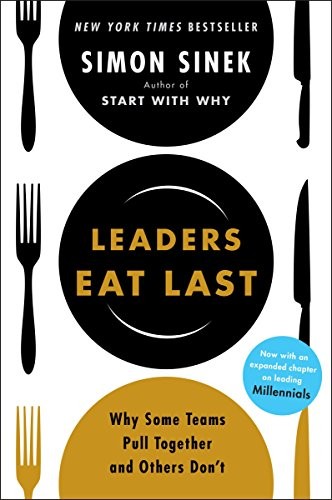
In the US Marine Corps, officers traditionally line up for meals after their troops have been served. Leaders Eat Last, published in 2014, uses that custom as a symbol of leadership: those in charge put the needs of the people first. Simon Sinek, the author of Start with Why, mixes stories from the military and business with ideas from biology and anthropology. The book’s central question is why some teams feel safe and loyal and others feel anxious and cutthroat. Here’s a summary of its key ideas.
Table of Contents
Leaders Eat Last at a Glance
| Detail | Info |
|---|---|
| Author | Simon Sinek |
| Published | 2014 |
| Genre | Leadership, business |
| Core idea | Leaders build trust by creating a Circle of Safety |
| Structure | Several parts covering safety, biology, culture and responsibility |
| Best for | Managers, team leaders, parents and anyone who wants a healthier workplace |
What Is Leaders Eat Last About?
Sinek begins with a story about Captain William Swenson, who received the Medal of Honor for his actions in Afghanistan in 2009, when he risked his life to help wounded comrades. Sinek asks what makes people willing to make such sacrifices, and concludes that it’s the bond created when people feel they belong to a group that cares for them.
He calls this protective space the Circle of Safety. When leaders create it, people feel secure from internal threats such as politics and favoritism, and can face external challenges together. When leaders fail to create it, employees spend energy protecting themselves, and trust erodes.
Key Ideas, Part by Part
The Circle of Safety
Humans evolved in small groups where survival depended on cooperation. Sinek says that our brains still look for signals of safety, and that a workplace that provides them becomes a place people want to stay. Leaders set the tone by how they treat people, and their actions show whether the team can count on them.
He gives the example of companies that avoid layoffs during downturns by sharing sacrifices, such as shorter hours or pay cuts across the board. Barry-Wehmiller, a manufacturing company led by Bob Chapman, is one example Sinek holds up as a firm that chose furloughs over mass layoffs in the 2008 recession.
The Chemicals of Leadership
Sinek explains behavior through four chemicals that he abbreviates as EDSO. Endorphins mask pain and encourage endurance. Dopamine rewards progress toward goals. Serotonin is linked to pride and status, and oxytocin is associated with trust, friendship and generosity. He argues that good leaders support the cooperative chemicals, serotonin and oxytocin, while bad systems rely too heavily on dopamine-driven targets.
He also describes cortisol, a stress chemical that prepares the body to cope with threat. Chronic stress at work, he argues, keeps people in a defensive mode that harms health, creativity and relationships. This is a simplified way to talk about complex brain science, so treat it as a metaphor.
The Danger of Abstraction and Numbers
Sinek warns that when leaders become distant from the people they affect, decisions become abstract. It’s easier to cut jobs when they’re numbers on a spreadsheet than when you know the people involved. He criticizes cultures that chase quarterly figures and bonuses at the expense of relationships and long-term health.
He argues that leaders should stay close to their teams, meet them in person and remember that numbers describe people. Smaller groups and regular contact help keep empathy alive.
Becoming a Leader Who Eats Last
The final sections discuss how to apply the ideas. Leadership, Sinek says, is a choice, not a rank. Anyone can create a small circle of safety by listening, giving credit and showing up for others. He encourages leaders to take responsibility for their people’s well-being and to hire for character as well as skills.
He also touches on society more broadly, asking how technology, social media and addictive habits may weaken real relationships. Building trust takes time, patience and presence, he concludes, and it begins with small acts.
6 Key Takeaways From Leaders Eat Last
- Create a Circle of Safety. People do their best work when they feel protected.
- Leaders go first in sacrifice. Putting others first builds loyalty.
- Trust is chemical and cultural. Cooperation grows when people feel valued and connected.
- Avoid abstraction. Stay close to the people your decisions affect.
- Don’t chase numbers alone. Short-term targets can harm trust and long-term health.
- Leadership is a choice. Anyone can look after the people around them.
Ideas Worth Remembering
- Leaders are responsible for the people in their care, not just the results. (paraphrased)
- Safety inside the group frees people to face outside challenges. (paraphrased)
- Stress and fear shrink cooperation; trust expands it. (paraphrased)
- Small, consistent gestures build a culture over time. (paraphrased)
How to Apply Leaders Eat Last in Real Life
- Listen first. Start meetings by asking how people are, and mean it.
- Share the pain. In hard times, spread sacrifices instead of cutting only at the bottom.
- Give credit. Name the people behind good results publicly.
- Reduce internal threats. Address office politics, blame and favoritism quickly.
- Stay close. Spend time with the people your decisions affect.
Criticisms and Limits
Some readers feel the book oversimplifies the science, since the neurochemical explanations are presented as more direct than researchers would claim. Others note that the book offers fewer step-by-step tools than it does inspiring stories, and that the military analogies don’t always translate to for-profit workplaces. A few critics point out that organizations Sinek praised later faced their own difficulties.
The book is most useful as a reminder that culture and trust matter. Take the stories as inspiration, and treat the biology as illustration, not proof.
Eating Last in Everyday Work
You don’t need a big title to apply the idea. A team member can offer to cover a colleague who is overwhelmed, share credit with someone who helped or speak up when a coworker is treated unfairly. Managers can protect their teams from unnecessary pressure by absorbing blame when things go wrong and passing on praise when they go right. Small gestures like these, repeated over time, signal that people are valued.
The Leadership Lessons From the Military
Sinek draws heavily on military examples because they show trust under extreme pressure. In units where leaders share hardship and know their people, soldiers report a strong sense of loyalty. Sinek notes, though, that the military also depends on training, clear roles and a sense of purpose. Civilians can borrow the principles without copying the structure: build shared purpose, train well and treat people as members of a team, not as tools.
Questions to Ask Your Own Team
To check your own Circle of Safety, ask questions such as: Do people feel comfortable admitting mistakes? Do we reward cooperation as much as individual results? Would colleagues describe leaders here as caring? Are decisions explained or just announced? Honest answers, ideally gathered anonymously, can reveal where trust is strong and where it needs repair.
Leaders Eat Last in One Minute
Great leaders build a Circle of Safety so that people feel protected from internal threats and can face outside challenges together. They share sacrifice, stay close to the people affected by their decisions and avoid managing by numbers alone. Trust grows when leaders go first, give credit and take responsibility. Fear and constant pressure create a defensive culture. Leadership is a choice anyone can make, with or without a title.
Building Trust Remotely
Remote and hybrid teams can lose the casual contact that builds trust. Sinek’s ideas suggest ways to rebuild it. Begin calls with real check-ins, use video when it helps and make time for informal conversation. Be clear about expectations so that people do not feel watched or judged unfairly. Recognize contributions publicly and respond promptly when someone is struggling. Because trust is built through repeated small acts, consistency matters more than grand gestures.
Common Mistakes Leaders Make
A few patterns erode safety. Leaders who take credit but blame others teach employees to hide problems. Constantly shifting priorities create stress and a feeling that effort is wasted. Rewarding only individual wins can set colleagues against one another. Ignoring burnout signals leads to turnover. Sinek’s advice is to notice these patterns early, repair them openly and design incentives that encourage cooperation. A sincere apology can do a lot to restore trust.
Who Should Read Leaders Eat Last?
Read it if you manage people, run an organization or want to understand why some workplaces feel safe and others don’t. It suits readers who enjoy leadership stories. If you haven’t read Start with Why, begin there, then continue with this book.
What to Read Next
- Start with Why by Simon Sinek the case for leading with purpose
- Dare to Lead by Brene Brown courageous, empathetic leadership
- Extreme Ownership by Jocko Willink and Leif Babin a Navy SEAL view of leadership
Related: Start with Why summary and key takeaways and The 7 Habits of Highly Effective People summary and key takeaways.
Frequently Asked Questions
What is the main idea of Leaders Eat Last?
That leaders should create a Circle of Safety so people feel protected, which builds trust and teamwork.
What does leaders eat last mean?
It comes from a Marine Corps custom in which officers eat after their troops, symbolizing putting others first.
What is the Circle of Safety?
A culture where people feel secure within the group and can focus on external challenges.
What are EDSO chemicals?
Endorphins, dopamine, serotonin and oxytocin, which Sinek links to motivation, pride and trust.
Should I read Start with Why first?
It helps but isn’t required; the books stand on their own.