

Disclosure: As an Amazon Associate, Bookish Wisdom earns from qualifying purchases. This doesn’t change our picks or your price.
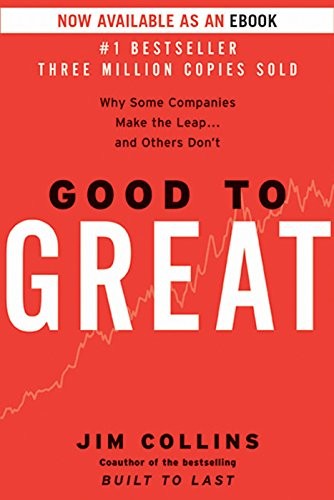
TL;DR: Good to Great: Why Some Companies Make the Leap and Others Don’t by Jim Collins studies eleven companies that outperformed the market for fifteen years after a long period of average results. Collins identifies common traits, including Level 5 leadership, getting the right people first, facing the brutal facts and the Hedgehog Concept, that helped these firms turn good into great.
Many companies are good, but few become great. Good to Great, published in 2001, is the result of a five-year research project led by Jim Collins and his team, who screened 1,435 companies to find those that shifted from average results to extraordinary ones and stayed there. The book became one of the best-selling business titles of its era, and its terms, like flywheel and Hedgehog Concept, are common in management talk. It has also drawn criticism, partly because some of the featured companies later struggled. Here’s a summary of its main ideas.
Table of Contents
Good to Great at a Glance
| Detail | Info |
|---|---|
| Author | Jim Collins |
| Published | 2001 |
| Genre | Business, management |
| Core idea | Disciplined people, thought and action turn good companies into great ones |
| Structure | Chapters on leadership, people, facts, focus, discipline, technology and the flywheel |
| Best for | Leaders, managers, entrepreneurs and strategy students |
What Is Good to Great About?
Collins’s team looked for companies whose stock returns were at or below the market for fifteen years, then jumped to at least three times the market over the next fifteen. Eleven companies met the standard, including Abbott, Gillette, Kimberly-Clark, Nucor, Walgreens and Wells Fargo. The team then compared each with a similar company that did not make the leap, to learn what was different.
The findings are presented as a set of concepts, each with a chapter. The goal was to identify patterns that held across industries, not a single formula.
Key Ideas, Part by Part
Level 5 Leadership and First Who
Collins found that the leaders of great companies were not flashy celebrities. They combined personal humility with fierce professional will. He calls them Level 5 leaders. They credited others for success and took responsibility for failure, and they cared more about the company’s lasting success than their own fame.
The second concept, first who, then what, says that leaders first get the right people on the bus, the wrong people off and the right people in the right seats, and only then decide where to drive. Great companies focused on character and fit before skills, and built teams that could adapt when the direction changed.
Confront the Brutal Facts
Great companies created cultures in which truth was heard. Leaders asked questions, held honest conversations and listened to the answers. Collins illustrates this with the Stockdale Paradox, named for Admiral James Stockdale, a prisoner of war in Vietnam, who kept faith that he would prevail in the end while confronting the brutal reality of his situation. The lesson is to combine realistic assessment with unwavering belief that you will succeed.
He suggests building mechanisms that surface bad news, such as red flag reviews and regular post-mortems, so leaders aren’t surprised.
The Hedgehog Concept
Drawing on the essay The Hedgehog and the Fox, Collins argues that great companies behave like hedgehogs, which know one big thing, instead of foxes, which pursue many ideas. The Hedgehog Concept is found at the intersection of three circles: what you can be the best in the world at, what drives your economic engine and what you are deeply passionate about.
Collins gives the example of Walgreens, which chose to be the best convenient drugstore, and of Nucor, which focused on a steel-making approach built on efficient mini-mills. The concept isn’t a goal or a strategy; it’s an understanding that guides what to pursue and what to decline.
A Culture of Discipline and Technology Accelerators
Disciplined people, thought and action form a culture in which freedom exists within a framework. Great firms don’t need heavy bureaucracy because they hire self-disciplined people. They also create a stop-doing list, as well as a to-do list.
Collins found that technology alone doesn’t create greatness. Great companies were careful about technology, adopting it only when it fit their Hedgehog Concept, and used it as an accelerator, not a source of momentum.
The Flywheel and the Doom Loop
Transformations did not occur in a single dramatic moment. Collins uses the image of a heavy flywheel that is pushed steadily, turn after turn, until momentum builds. Good-to-great companies gained momentum through consistent effort, with each success reinforcing the next.
Comparison companies tended toward the doom loop, lurching from one new program to another without building lasting momentum.
6 Key Takeaways From Good to Great
- Humble but driven leaders win. Level 5 leaders put the company’s success ahead of ego.
- People come first. Get the right people in the right seats before setting direction.
- Face reality. Seek the truth while keeping faith in the long term.
- Find your Hedgehog Concept. Focus where passion, ability and economics overlap.
- Build discipline. Hire disciplined people and stop doing things that do not matter.
- Push the flywheel. Steady, consistent effort accumulates into breakthroughs.
Ideas Worth Remembering
- Greatness is usually the result of sustained, disciplined effort, not a single big move. (paraphrased)
- Say no to good opportunities that don’t fit your core strength. (paraphrased)
- A hard truth discovered early is cheaper than one discovered late. (paraphrased)
- Technology helps most when it supports a clear strategy. (paraphrased)
How to Apply Good to Great in Real Life
- Audit your team. Ask whether everyone is in the right role and aligned with values.
- Draw your three circles. List what you are passionate about, what you can excel at and what pays.
- Create a stop-doing list. Drop activities that distract from your core.
- Hold truth sessions. Meet regularly to discuss problems without blame.
- Track your flywheel. Identify the actions that create momentum and repeat them.
Criticisms and Limits
Critics argue that Collins’s method suffers from selection bias, since he looked backward at winners and may have mistaken luck for causes. Because several of the companies later struggled, some say the book’s lessons don’t predict long-term success. Others note that the sample is small, and that some conclusions, like the downplaying of technology, may not suit today’s tech-driven markets.
Even so, the ideas on leadership, hiring and focus remain widely used. Treat the book as a collection of thoughtful hypotheses rather than a guaranteed recipe.
Using the Hedgehog Concept Personally
The three circles work for careers as well as companies. Ask what you love doing, what you could be among the best at and what the market will pay for. The overlap suggests where to focus. If the circles don’t overlap yet, consider which skills to build or which interests to explore. Collins notes that clarity often comes slowly, through experiments and reflection, not a single epiphany.
Good to Great for Small Teams and Nonprofits
Collins later published a monograph, Good to Great and the Social Sectors, which adapted the ideas for nonprofits, schools and other groups where profit isn’t the measure. In those settings, the economic engine becomes resources, such as time, money and brand, and the focus shifts to results suited to the mission. Small teams can use the same questions: Who are the right people, what are the brutal facts and what is our one big thing?
What Happened to the Companies Afterward
Some featured companies kept thriving, while others faced setbacks. Circuit City filed for bankruptcy in 2008 and Fannie Mae was rescued by the US government during the 2008 financial crisis. Collins responded in a later book, How the Mighty Fall, which describes stages of decline. The pattern is a reminder that success is not permanent and that the principles in the book require ongoing discipline.
Good to Great in One Minute
Good companies become great through discipline, not drama. Level 5 leaders blend humility with will. They get the right people on the bus, confront the brutal facts and keep faith that they will prevail. They find a Hedgehog Concept at the overlap of passion, ability and economic engine, build a culture of discipline and use technology as an accelerator. Momentum comes from pushing the flywheel steadily, not from a single big program.
The Stockdale Paradox in Daily Life
The Stockdale Paradox is useful beyond business. Imagine you are job hunting, recovering from illness or running a small business through a slow year. The paradox says to stay honest about how hard things are while keeping real belief that you will come through. In practice, that means tracking facts such as savings, applications or sales, adjusting your plan when the numbers say so and avoiding both false optimism and despair. People who combine the two tend to keep going longer.
Questions for Your Next Strategy Meeting
You can use the book as a discussion guide. Ask: Who are the right people for the next stage, and are they in the right seats? What facts are we avoiding? What can we be best in the world at, and what can’t we? What should we stop doing? What is our flywheel, and what small action will make it turn faster? Writing short answers and revisiting them each quarter keeps the ideas practical.
Who Should Read Good to Great?
Read it if you lead a business, manage a team or study strategy. It suits readers who like research-based management writing and don’t mind a long, detailed book. If you prefer shorter reads, pair it with a concise leadership book like Start with Why.
What to Read Next
- Built to Last by Jim Collins and Jerry Porras what makes visionary companies endure
- The Lean Startup by Eric Ries a method for building new ventures
- Essentialism by Greg McKeown the discipline of doing less, but better
Related: Start with Why summary and key takeaways and Leaders Eat Last summary and key takeaways.
Frequently Asked Questions
What is the main idea of Good to Great?
That companies become great through disciplined people, thought and action built up steadily, not through dramatic change.
What is a Level 5 leader?
A leader who combines personal humility with strong professional will, putting the company first.
What is the Hedgehog Concept?
A focus at the intersection of what you are passionate about, can be best at and what drives your economy.
What is the flywheel?
A metaphor for steady, cumulative effort that builds momentum over time.
Is Good to Great still worth reading?
Yes, as a source of ideas, though critics note selection bias and later setbacks at some companies.