

Disclosure: As an Amazon Associate, Bookish Wisdom earns from qualifying purchases. This doesn’t change our picks or your price.
TL;DR: Make It Stick explains what learning science says about how we really learn. Popular habits like rereading and highlighting create an illusion of mastery. Strategies that feel harder, like testing yourself, spacing out practice and mixing up topics, produce deeper, longer-lasting learning. Effortful learning works better than easy learning.
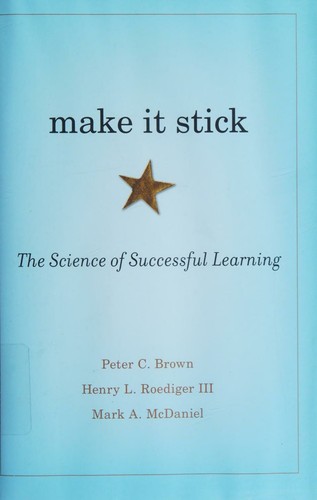
Published in 2014, Make It Stick: The Science of Successful Learning brings together decades of cognitive psychology research. It’s co-written by storyteller Peter C. Brown and two psychologists from Washington University in St. Louis, Henry L. Roediger III and Mark A. McDaniel, who have studied learning and memory for decades. The book uses stories of students, doctors, pilots and athletes to show the research in action.
Table of Contents
Make It Stick at a Glance
| Detail | Info |
|---|---|
| Authors | Peter C. Brown, Henry L. Roediger III and Mark A. McDaniel |
| Published | 2014 |
| Genre | Education / psychology / learning |
| Structure | Chapters on misconceptions about learning and the strategies that work, ending with tips for learners, teachers and trainers |
| Best for | Students, teachers, parents, trainers and lifelong learners |
What Is Make It Stick About?
The authors argue that much of how we study is based on intuition and habit, not evidence. Rereading notes and cramming feel productive because the material becomes familiar, but familiarity isn’t the same as knowing. Real learning requires effort to retrieve and apply knowledge.
Key Ideas From Make It Stick
Retrieval Practice
Recalling information from memory, through quizzes, flashcards or explaining something without notes, strengthens memory far more than rereading. The authors describe this as one of the most powerful learning strategies. Low-stakes testing isn’t just for measuring learning; it causes learning.
Spaced Practice
Spreading study sessions out over time leads to better long-term retention than cramming. Some forgetting between sessions makes retrieval harder, which strengthens memory.
Interleaving
Mixing different types of problems or topics, instead of practicing one type in a block, helps learners distinguish between problem types and choose the right approach. It feels slower but produces better results.
Desirable Difficulties
A term from psychologist Robert Bjork, desirable difficulties are challenges that slow learning in the short term but improve it in the long run, like retrieval, spacing and interleaving.
Elaboration and Generation
Elaboration means connecting new material to what you already know and explaining it in your own words. Generation means trying to answer a question or solve a problem before being shown the solution. Both deepen understanding.
Reflection and Calibration
Reflecting on what you’ve learned and testing yourself helps you calibrate: aligning your sense of what you know with what you actually know. This guards against overconfidence.
The Illusion of Knowing
Fluency, the ease of reading familiar material, tricks us into thinking we’ve mastered it. The authors warn that our judgments of our own learning are often wrong.
Learning Styles Fall Short
The book discusses research showing little evidence that matching instruction to a preferred learning style, like visual or auditory, improves learning. It’s better to match teaching to the content and to use varied approaches.
Growth Mindset and Mnemonics
The authors note that believing intelligence can grow encourages effort, and that memory techniques like memory palaces can help organize large amounts of information.
5 Key Takeaways From Make It Stick
- Test yourself often. Retrieval practice strengthens memory more than rereading.
- Space it out. Spread study sessions over days and weeks.
- Mix it up. Interleaving different topics builds flexible understanding.
- Embrace effort. Learning that feels hard often sticks better.
- Don’t trust familiarity. Quiz yourself to know what you really know.
Ideas Worth Remembering
- Learning is deeper and more durable when it’s effortful. (paraphrased)
- Rereading creates familiarity, not mastery. (paraphrased)
- Testing is a tool for learning, not just measuring. (paraphrased)
Who Should Read Make It Stick?
It’s essential for students of any age, teachers, parents helping with homework, corporate trainers and anyone learning new skills. Its advice is practical and backed by solid research, making it one of the best books on studying effectively.
What to Read Next
- Ultralearning by Scott H. Young on aggressive self-directed learning.
- Moonwalking with Einstein by Joshua Foer on memory techniques.
- Mindset by Carol S. Dweck on beliefs that encourage learning.
Related: 12 tips to remember what you read and So Good They Can’t Ignore You summary.
Frequently Asked Questions
What is the main idea of Make It Stick?
The main idea is that effortful learning strategies, such as retrieval practice, spacing and interleaving, produce deeper and longer-lasting learning than rereading or cramming.
What is retrieval practice?
Retrieval practice is recalling information from memory, such as with quizzes or flashcards. The act of retrieving strengthens the memory and makes it easier to recall later.
Does Make It Stick say learning styles are a myth?
The authors explain that research offers little support for teaching to individual learning styles, and they recommend matching instruction to the content and using varied methods instead.