
Disclosure: As an Amazon Associate, Bookish Wisdom earns from qualifying purchases. This doesn’t change our picks or your price.
TL;DR: In The Anxious Generation, social psychologist Jonathan Haidt argues that a sharp rise in teen anxiety and depression in the early 2010s was driven by the shift from a play-based childhood to a phone-based childhood. He proposes four norms: no smartphones before high school, no social media before 16, phone-free schools, and far more independence and free play in the real world.
Content note: this book discusses teen depression, self-harm and suicide. If you or a young person you know is struggling, call or text 988 in the US to reach the Suicide and Crisis Lifeline.
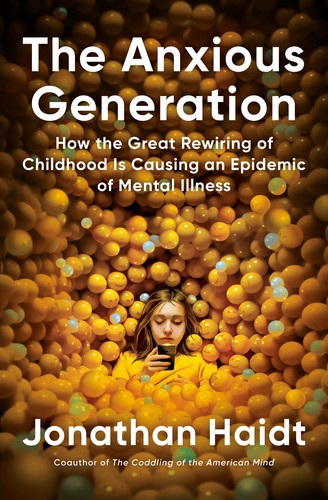
Published in 2024, The Anxious Generation: How the Great Rewiring of Childhood Is Causing an Epidemic of Mental Illness became a number-one bestseller and sparked a global movement around phone-free schools. Haidt, a professor at NYU’s Stern School of Business and co-author of The Coddling of the American Mind, draws on research data, charts and his collaboration with researcher Zach Rausch.
Table of Contents
The Anxious Generation at a Glance
| Detail | Info |
|---|---|
| Author | Jonathan Haidt |
| Published | 2024 |
| Genre | Psychology / parenting / technology |
| Structure | Four parts: the tidal wave, the decline of play-based childhood, the great rewiring and collective action for healthier childhoods |
| Best for | Parents, teachers, school leaders and policy makers |
What Is The Anxious Generation About?
Haidt shows data indicating that rates of anxiety, depression and self-harm among adolescents, especially girls, rose sharply beginning around 2012 in the US and several other countries. He argues the timing points to what he calls the great rewiring of childhood, roughly between 2010 and 2015, when smartphones, front-facing cameras, fast internet and social media apps became part of everyday teenage life.
Key Ideas From The Anxious Generation
Overprotection in the Real World, Underprotection Online
Haidt argues that adults have made children’s real-world lives too safe, limiting unsupervised play and independence, while leaving their online lives largely unprotected. Children lost the experiences that build resilience and gained constant exposure to platforms not designed for them.
The Decline of Play
Free play, especially risky, unsupervised play with other kids, helps children learn to manage fear, solve problems and get along with peers. Haidt describes how this declined from the 1990s onward, even before smartphones, as parents grew more fearful.
The Four Foundational Harms
Haidt identifies four ways phone-based childhood harms development: social deprivation (less face-to-face time with friends), sleep deprivation (phones in bedrooms cutting into sleep), attention fragmentation (constant notifications making focus harder) and addiction (apps designed to keep users scrolling).
Why Girls and Boys Are Affected Differently
Haidt argues that girls are more affected by visual social media, social comparison and relational aggression, while boys have withdrawn more into video games, online content and isolation, contributing to what he describes as a failure to launch.
The Four Norms
- No smartphones before high school. Give younger children basic phones for communication instead.
- No social media before 16. Wait until the brain is past the most vulnerable stage of early puberty.
- Phone-free schools. Use lockable pouches or lockers for the whole school day.
- Far more unsupervised play and childhood independence. Let kids walk to school, run errands and play freely.
Haidt emphasizes that these work best as collective action, since no parent wants their child to be the only one without a phone.
5 Key Takeaways From The Anxious Generation
- Childhood changed fast. The shift to phone-based childhood happened in just a few years.
- Play builds resilience. Kids need real-world independence and risk.
- Phones have hidden costs. Sleep, attention and in-person connection all suffer.
- Delay smartphones and social media. Timing matters for developing brains.
- Act together. Families and schools adopting norms together makes change easier.
Ideas Worth Remembering
- We overprotect children in the real world and underprotect them online. (paraphrased)
- Play is the work of childhood. (paraphrased)
- Collective action solves problems no single family can solve alone. (paraphrased)
What Do Critics Say?
Some researchers, notably psychologist Candice Odgers in a review in the journal Nature, argue that the evidence shows correlation but not clear causation, and that other factors may explain rising teen distress. Haidt has responded by pointing to experimental and longitudinal studies. The debate continues, but many parents and schools find his recommendations sensible and low-risk.
Who Should Read The Anxious Generation?
It’s essential reading for parents of children and teens, teachers, school administrators and policy makers. Teens and young adults also find it eye-opening about their own experiences.
What to Read Next
- The Coddling of the American Mind by Greg Lukianoff and Jonathan Haidt on overprotection and fragility.
- Digital Minimalism by Cal Newport on healthier technology habits.
- Stolen Focus by Johann Hari on the forces eroding our attention.
Related: Digital Minimalism summary and best books for reluctant readers in middle school.
Frequently Asked Questions
What is the main argument of The Anxious Generation?
The main argument is that the shift from play-based to phone-based childhood between about 2010 and 2015 contributed to a sharp rise in adolescent anxiety and depression.
What are the four norms in The Anxious Generation?
No smartphones before high school, no social media before 16, phone-free schools, and far more unsupervised play and childhood independence.
What are the four foundational harms?
Social deprivation, sleep deprivation, attention fragmentation and addiction.