
Disclosure: As an Amazon Associate, Bookish Wisdom earns from qualifying purchases. This doesn’t change our picks or your price.
TL;DR: Meditations by Marcus Aurelius is a collection of private notes written by a Roman emperor to remind himself how to live by Stoic principles. Its themes include focusing on what you control, accepting change and death, acting with duty and kindness and keeping perspective in the face of stress and criticism.
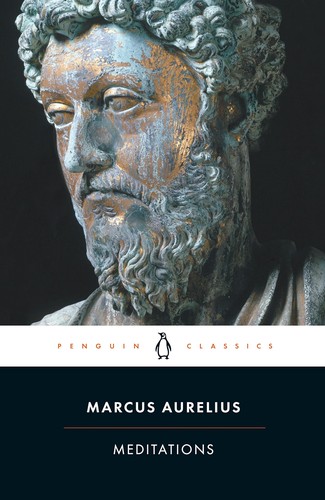
Marcus Aurelius ruled the Roman Empire from 161 to 180 CE, a time of war, plague and political strain. Late in his life he wrote a set of notes to himself, probably never meant for publication, which have come to be known as Meditations. The original Greek title is often translated as To Himself. The text is made up of twelve short books, mostly aphorisms and reflections. It remains one of the most widely read works of ancient philosophy. Here’s a summary of its main ideas. Translations differ, so wording in your edition may vary.
Table of Contents
Meditations at a Glance
| Detail | Info |
|---|---|
| Author | Marcus Aurelius |
| Written | Around 170 to 180 CE |
| Genre | Philosophy, Stoicism, personal notes |
| Core idea | Live by reason and virtue, focusing on what is in your control |
| Structure | Twelve books of short reflections |
| Best for | Readers interested in Stoicism, leadership and practical wisdom |
What Is Meditations About?
Marcus belonged to the Stoic school of philosophy, which taught that virtue, meaning wisdom, justice, courage and self-control, is the only true good, and that external things such as wealth or fame are indifferent. Stoics held that we can’t control events, but we can control our judgments and responses.
The notes aren’t a systematic treatise but a personal exercise. Marcus reminds himself, over and over, to stay calm, to be useful and to keep perspective. Many entries begin with phrases such as Remember or Tell yourself, which show that he was practicing the ideas.
Key Ideas, Part by Part
Control and Perception
A recurring theme is that our suffering often stems from our judgments about events, not the events themselves. Marcus advises himself to strip things down to their basic facts and to see them without exaggeration. He writes that you have power over your mind, not outside events, and that realizing this gives you strength.
He also reminds himself that obstacles can become the material for action. The impediment to action advances action, as one often-quoted line puts it. Instead of resenting difficulties, he tries to use them to practice virtue.
Impermanence and Death
Marcus often reflects on how short life is and how quickly fame and memory fade. He mentions the great figures of the past, now forgotten, to keep himself humble. Remembering death, he suggests, encourages us to act well now and to avoid wasting time on petty concerns.
This is not morbid. It is meant to sharpen priorities and encourage gratitude. He also accepts change as the nature of the universe, comparing life to a river and urging acceptance of whatever comes.
Duty, Community and Kindness
Though he was an emperor, Marcus stresses that humans are made for cooperation. He writes that we are born to work together like feet, hands, eyelids and rows of teeth. When dealing with difficult people, he reminds himself that they act out of ignorance, and he tries to respond with patience rather than anger.
He also emphasizes duty, getting up in the morning to do the work of a human being. He urges himself to avoid complaining, to do his job well and to serve the common good. Book One opens with gratitude to the teachers, family and friends who shaped his character.
Self-Discipline and Simplicity
Marcus advises himself to live simply, to avoid vanity and to be honest in thought and action. He warns against seeking praise, noting that the opinions of others are fickle. He encourages himself to stop debating what a good person is and just be one.
The notes show a man struggling to apply his ideals while carrying out heavy responsibilities, which makes the book feel human and relatable. Its honesty about frustration and fatigue is part of its appeal.
6 Key Takeaways From Meditations
- Focus on what you control. Your judgments and actions are yours.
- Perception shapes pain. See things as they are.
- Remember mortality. Use time well.
- Work for the common good. Humans are made to cooperate.
- Be patient with others. Assume ignorance, not malice.
- Practice daily. Return to your principles repeatedly.
Ideas Worth Remembering
- You have power over your mind, not over outside events. (paraphrased)
- The obstacle can become the way. (paraphrased)
- Be a good person instead of arguing about it. (paraphrased)
- Little things are not small to the character that practices them. (paraphrased)
How to Apply Meditations in Real Life
- Start your day with intention. Remind yourself of your priorities each morning.
- Sort what you control. List worries and mark which are within your power.
- Pause before reacting. Ask whether anger will help.
- Reflect each evening. Review what you did well and what to improve.
- Do your duty. Do the next right thing without complaint.
Criticisms and Limits
Critics note that the book is repetitive and fragmentary, which can make it hard to read as a continuous work. Its Stoic view can seem austere or even passive, and some readers find the advice to accept events troubling when applied to injustice. The text also reflects the limits of its time, including acceptance of social hierarchies and slavery, and some of its metaphysical claims, such as about nature and fate, are not widely held today.
Even so, its practical focus on self-control, perspective and duty has endured. Read it as a companion for reflection, not as a full philosophy.
Meditations in One Minute
Control your judgments, not outside events. See things clearly, accept change and remember that life is short. Do your duty, cooperate with others and be patient with difficult people. Live simply, avoid chasing praise and practice these reminders daily.
Choosing a Translation
Popular translations include Gregory Hays’s modern version, praised for readability, and George Long’s older version, available free online. Others include Robin Hard and Martin Hammond. Because the original is Greek and the text was not polished, translations differ in style. Try a few pages of each to see which one speaks to you, and look for a good introduction and notes.
How to Read the Book
Because Meditations is a set of notes, you can read a few passages at a time instead of cover to cover. Many readers keep it by the bed or on a desk, opening to a random page. Reading slowly and writing your reflections helps the ideas stick. Pair it with a guide such as The Daily Stoic if you want structure.
Marcus’s Context
The emperor faced wars on the frontiers, an outbreak of disease known as the Antonine Plague and betrayal by a general. He also dealt with the loss of several children. Knowing this background gives the calm tone of the Meditations more weight. They are the words of someone trying to remain steady while under real pressure, not a detached observer.
Morning and Evening Practice
Marcus’s notes suggest a daily routine you can copy. In the morning, remind yourself that you will meet difficult people and that you can handle them with patience. During the day, pause when you feel anger or fear and ask what you control. In the evening, review the day: where did you act well, and where could you improve? Writing two or three lines in a notebook turns the ideas into habits.
Marcus and Modern Psychology
Many of Marcus’s techniques echo modern cognitive therapy: separating facts from interpretations, noticing automatic thoughts and focusing on actions. Researchers have noted similarities between Stoic practice and approaches such as CBT. This does not make the book a medical treatment, but it shows why people find it calming. If stress becomes overwhelming, combine reading with support from friends or a professional.
Who Should Read Meditations?
Read it if you are curious about Stoicism, enjoy classic literature or want a calm voice for stressful times. It suits readers who like short, reflective passages. For a modern companion, try The Daily Stoic.
What to Read Next
- The Daily Stoic by Ryan Holiday and Stephen Hanselman 366 days of Stoic wisdom
- Letters from a Stoic by Seneca practical advice on living well
- Enchiridion by Epictetus a short handbook of Stoic teachings
Related: books like Meditations and The Daily Stoic summary and key takeaways.
Frequently Asked Questions
What is the main idea of Meditations?
That a good life is lived through reason, virtue and acceptance of what you cannot control.
Who was Marcus Aurelius?
A Roman emperor and Stoic philosopher who ruled from 161 to 180 CE.
Did Marcus Aurelius write Meditations for publication?
Probably not; the notes were for his own use.
Which translation should I read?
Gregory Hays’s is popular for clarity; George Long’s is older and free.
Is Meditations hard to read?
It is short and aphoristic, though some passages are cryptic.