

Disclosure: As an Amazon Associate, Bookish Wisdom earns from qualifying purchases. This doesn’t change our picks or your price.
TL;DR: Sapiens by Yuval Noah Harari tells the history of humankind in four parts: the Cognitive Revolution, the Agricultural Revolution, the unification of humankind and the Scientific Revolution. Harari argues that humans dominate the planet because they can cooperate flexibly in large numbers through shared stories such as money, nations and corporations.
Sapiens was first published in Hebrew in 2011 and in English in 2014, and it has sold millions of copies worldwide. Yuval Noah Harari, a historian at the Hebrew University of Jerusalem, set out to tell the story of our species from the first humans to the present, with a focus on big questions: why did Homo sapiens survive when other human species disappeared, what changed when we began farming and are we happier today than we were in the past? The book is provocative, wide-ranging and sometimes controversial. Here’s a summary of its four parts and key ideas.
Table of Contents
Sapiens: A Brief History of Humankind at a Glance
| Detail | Info |
|---|---|
| Author | Yuval Noah Harari |
| Published | 2011 (Hebrew), 2014 (English) |
| Genre | History, anthropology, science |
| Core idea | Shared fictions let large groups of humans cooperate |
| Structure | Four parts spanning about 70,000 years |
| Best for | Readers who enjoy big-picture history and provocative ideas |
What Is Sapiens: A Brief History of Humankind About?
Harari begins by noting that about 100,000 years ago, at least six human species lived on Earth, and only Homo sapiens survived. His thesis is that sapiens succeeded because of a unique ability, which emerged around 70,000 years ago, to imagine things that don’t exist and to believe in them together. These shared fictions, such as gods, nations, money and human rights, allow strangers to cooperate flexibly in large numbers.
He calls these shared beliefs imagined orders, and he argues that they shape societies as strongly as physical reality. The book traces how these stories grew in scale and power, from small bands to global empires, and how they interact with biology and technology.
Key Ideas, Part by Part
Part One: The Cognitive Revolution
Harari describes the period around 70,000 years ago when sapiens developed complex language and spread out of Africa. He suggests that language evolved for gossip, which helped groups track relationships, and that the capacity for fiction allowed cooperation among hundreds of people instead of dozens. Sapiens migrated to Australia and the Americas, and Harari argues that waves of extinction of large animals followed their arrival.
He also describes the hunter-gatherer lifestyle, arguing that early humans may have enjoyed a richer diet and more leisure than later farmers, though evidence is debated.
Part Two: The Agricultural Revolution
About 12,000 years ago, humans began to domesticate plants and animals. Harari calls this the biggest fraud in history, because although it allowed larger populations, it often led to harder work, worse diets and new diseases for individuals. In his view, wheat domesticated humans as much as the reverse, binding them to fields.
The revolution also created surplus and social hierarchies. As societies grew, they needed systems for record-keeping, leading to the invention of writing, and for governing large numbers of people, leading to myths of law and hierarchy. He argues that many hierarchies, such as caste and racism, are imagined orders that appear natural but are social constructs.
Part Three: The Unification of Humankind
This part describes how small societies merged into large networks through three universal orders: money, empires and religions. Money, Harari says, is the most universal and most efficient system of mutual trust, because it lets strangers cooperate. Empires spread cultures and trade, and religions provided shared values that held diverse groups together.
He argues that the arc of history moves toward unification, and that empires, though often brutal, shaped modern identities and exchanges. He also discusses how shared myths, such as the idea of a universal truth, enable large-scale cooperation.
Part Four: The Scientific Revolution
The last part covers the past 500 years, which Harari sees as defined by the discovery of ignorance: the realization that humans don’t know everything and can learn more through observation and mathematics. He explores the partnership of science, empire and capitalism, noting how European exploration, financed by credit, drove both knowledge and conquest.
He then considers the industrial revolution, consumerism and the question of happiness, asking whether modern comforts have made people happier. The book ends by pondering the future of Homo sapiens, as biotechnology, artificial intelligence and engineering might change our species or replace it.
7 Key Takeaways From Sapiens: A Brief History of Humankind
- Shared stories enable cooperation. Money, nations and corporations are real because we believe in them.
- The Cognitive Revolution changed everything. Language and imagination let large groups work together.
- Farming had costs. The agricultural revolution may have worsened individual lives.
- Hierarchies are constructed. Many social orders are imagined, not natural.
- Money builds trust. It allows strangers to cooperate.
- Science began with ignorance. Admitting what we don’t know opened the way to progress.
- Progress isn’t the same as happiness. Material improvement doesn’t guarantee well-being.
Ideas Worth Remembering
- Large-scale cooperation depends on beliefs that exist only in our collective imagination. (paraphrased)
- Many aspects of human life that feel natural are social constructions. (paraphrased)
- Admitting ignorance has been a powerful engine of discovery. (paraphrased)
- More power does not necessarily mean more happiness. (paraphrased)
How to Apply Sapiens: A Brief History of Humankind in Real Life
- Question imagined orders. Ask which of your assumptions about society are based on convention, not nature.
- Notice shared stories. See how brands, nations and money rely on collective belief.
- Think long-term. Consider the effects of technology on future generations.
- Stay curious. Treat admitting ignorance as a first step to learning.
- Read widely. Compare Harari’s claims with other historians.
Criticisms and Limits
Scholars have pointed out factual errors and overstatements in Sapiens, from its claims about the agricultural revolution to its generalizations about hunter-gatherers and its portrayal of animal suffering. Critics also say that its style, with bold claims and few citations in the main text, can make speculation sound like settled fact.
Despite these concerns, the book is valued for its clear writing and its encouragement to think big. Many readers use it as a gateway to deeper study, and it has helped popularize questions about the role of stories, power and technology in human history.
About Yuval Noah Harari
Yuval Noah Harari was born in 1976 in Israel and earned a PhD in history from the University of Oxford. He teaches at the Hebrew University of Jerusalem. After Sapiens, he wrote Homo Deus, about the future, and 21 Lessons for the 21st Century, about current challenges. He also published a series of illustrated books for younger readers. His work has influenced debates on technology and politics, and he is both admired and criticized for his sweeping claims.
Criticisms and Debates
Some historians and scientists say Sapiens oversimplifies complex subjects and presents debatable claims as facts. Critics have disputed its portrayal of hunter-gatherer life, its estimates of extinction causes and its treatment of religion and animals. Others praise its ability to make history exciting and to ask big questions. As with any popular synthesis, it works best as a conversation starter, and it’s wise to read specialized sources for details and to consider alternative views.
Imagined Orders in Everyday Life
Harari’s idea of imagined orders can be tested in daily life. A dollar bill has little intrinsic value, but we accept it because everyone else does. A company is a legal fiction, yet it can own property and sue. Human rights are not found in biology, but they shape laws and behavior. Seeing these structures as shared stories can make them easier to question and improve, and it can also help explain why changes in beliefs can transform societies quickly.
Pairing Sapiens With Other Books
Sapiens pairs well with Guns, Germs, and Steel by Jared Diamond, which looks at environmental and geographic factors in history, and with Homo Deus, its sequel. For a more cautious approach, read The Dawn of Everything by David Graeber and David Wengrow, which challenges some of Harari’s assumptions about early societies. For a more science-based view of human origins, look for books by evolutionary biologists and archaeologists. Reading several gives a fuller picture of how historians and scientists debate the human story.
A Short Glossary of Key Terms
Several terms recur. The Cognitive Revolution refers to the leap in thinking and language about 70,000 years ago. Imagined order means a set of shared beliefs that structure society. Homo sapiens means wise human, our species. The Agricultural Revolution was the shift to farming. Intersubjective describes things that exist in the shared minds of many people, such as money. Capitalism is described as a belief system built on credit and growth. Knowing these terms helps you follow the argument and discuss it with others.
How to Read Sapiens Critically
Because Sapiens covers so much ground, it’s useful to check its claims. Note where Harari offers evidence and where he speculates. Compare his statements about prehistory with sources such as museum websites or books by archaeologists. Ask whether alternative explanations exist, for example about the agricultural revolution or the extinction of megafauna. Treat the book as a thought-provoking essay on the human story rather than a final authority, and enjoy the way it connects biology, economics and ideas.
Who Should Read Sapiens: A Brief History of Humankind?
Read it if you like big-picture history and thought-provoking claims, if you want a readable overview of human evolution and civilization or if you’re curious about how beliefs shape societies. It’s long, around 400 pages, but written in a lively style. If you want a more academic approach, pair it with specialist works.
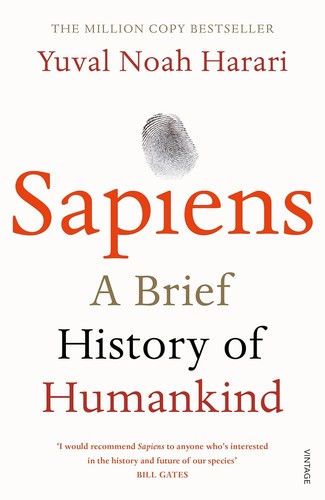
What to Read Next
- Homo Deus by Yuval Noah Harari Harari’s look at the future of humanity
- Guns, Germs, and Steel by Jared Diamond a classic on geography and the rise of civilizations
- The Dawn of Everything by David Graeber a challenge to common stories about early societies
Related: Homo Deus summary and key takeaways and Guns, Germs, and Steel summary and key takeaways.
Frequently Asked Questions
What is the main idea of Sapiens?
That humans dominate the planet because they can cooperate in large numbers through shared fictions such as money, nations and religions.
What are the four parts of Sapiens?
The Cognitive Revolution, the Agricultural Revolution, the unification of humankind and the Scientific Revolution.
What does Harari mean by imagined orders?
Shared beliefs, such as laws or money, that exist because people collectively accept them.
Is Sapiens accurate?
It’s engaging, but some scholars dispute parts of it. Read it as a stimulating overview, not a final authority.
What should I read after Sapiens?
Try Homo Deus or Guns, Germs, and Steel.