

Disclosure: As an Amazon Associate, Bookish Wisdom earns from qualifying purchases. This doesn't change our picks or your price.
TL;DR: Siddhartha Mukherjee writes a “biography” of cancer, tracing its history from ancient Egypt to modern medicine. He tells the stories of doctors, researchers, activists and patients who fought the disease, from radical surgery and the first chemotherapy to targeted drugs, while following his own patients.
Table of Contents
The Emperor of All Maladies at a Glance
| Author | Siddhartha Mukherjee |
| First published | 2010 |
| Type | Nonfiction |
| Best for | readers who want a powerful, accessible history of cancer |
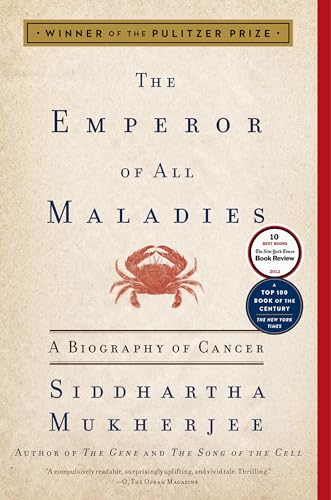
The Emperor of All Maladies: A Biography of Cancer is a book by oncologist Siddhartha Mukherjee, published in 2010. It won the 2011 Pulitzer Prize for General Nonfiction and became a PBS documentary. Below you will find a part-by-part summary, five key takeaways, ideas worth remembering and a note on who will enjoy it.
Content note: Includes illness, death and difficult medical details.
Key Concepts
- Sidney Farber: A pathologist who pioneered chemotherapy for childhood leukemia.
- Mary Lasker: An activist who championed cancer research funding.
- William Halsted: A surgeon who developed the radical mastectomy.
- Carla Reed: One of Mukherjee's leukemia patients.
- Brian Druker: A researcher behind the targeted drug Gleevec.
The Main Ideas, Part by Part
Ancient roots
Cancer is described in ancient Egyptian texts and Greek writings. For centuries, it was poorly understood and untreatable. Mukherjee opens with his patient Carla Reed, diagnosed with leukemia.
Surgery and early treatments
In the late 1800s, surgeon William Halsted developed the radical mastectomy, removing large amounts of tissue. Surgery became ever more aggressive, often without better results. Radiation was also introduced.
Chemotherapy
In 1947, Sidney Farber used the drug aminopterin to cause temporary remissions in children with leukemia. With activist Mary Lasker, he lobbied for funding, leading to the 1971 National Cancer Act and Nixon's “war on cancer.” Combination chemotherapy cured childhood leukemia and Hodgkin's lymphoma for many.
Prevention
Researchers linked smoking to lung cancer in the 1950s. Battles against tobacco companies followed. Screening tests like the Pap smear and mammography helped catch cancer earlier.
Understanding cancer
Scientists discovered oncogenes and tumor suppressor genes, showing cancer as a disease of mutated genes. Targeted drugs followed, like Herceptin for breast cancer and Gleevec for chronic myeloid leukemia. Carla goes into remission, and Mukherjee reflects on cancer as part of life.
5 Key Takeaways
- Cancer is many diseases, not one.
- Progress comes from science, advocacy and patients.
- Prevention can be as powerful as treatment.
- More aggressive treatment is not always better.
- Understanding genes transformed cancer care.
Ideas Worth Remembering
These are paraphrased, not direct quotes:
- Cancer is built into our genes.
- Hope must be based on evidence.
- Every patient is part of the story of progress.
Who Should Read The Emperor of All Maladies?
Read The Emperor of All Maladies if you want an engrossing history of medicine. It suits adults and older teens, especially those touched by cancer.
Questions to Think About After Reading
These prompts work for solo reading, a book club or a classroom discussion of The Emperor of All Maladies:
- Why did surgeons favor aggressive treatment?
- What role did activists play?
- Can cancer ever be fully cured?
How to Use This Summary
Use this page as a quick reference before a book club meeting, an exam, or a decision about whether The Emperor of All Maladies is worth your time. The takeaways are written to stand on their own. If a point interests you, go back to the book for the author's full argument, examples and evidence, which no short summary can replace.
A Note on Accuracy and Spoilers
This summary is based on the published text of The Emperor of All Maladies, not on any film, series or stage adaptation, which often change the story. Details are kept at the level of the main arguments so that nothing is invented. Editions differ slightly in length and wording, so page numbers and small details may vary between copies.
Should You Read the Book?
Yes. Mukherjee writes with compassion and narrative skill, making complex science clear. It is long and some sections are emotionally hard, especially for readers living with cancer. Note that treatments have advanced since 2010, including immunotherapy, so it is a history rather than a current guide.
Check price of The Emperor of All Maladies on Amazon
What to Read Next
- The Gene by Siddhartha Mukherjee: Mukherjee's history of genetics
- The Immortal Life of Henrietta Lacks by Rebecca Skloot: HeLa cells and ethics
- When Breath Becomes Air by Paul Kalanithi: a doctor faces cancer
Related: 15 Books Like The Emperor of All Maladies You’ll Love
Frequently Asked Questions
What is The Emperor of All Maladies about?
A history of cancer and the fight against it.
Did it win a Pulitzer?
Yes, in 2011.
Who was Sidney Farber?
A pioneer of chemotherapy.
What is Gleevec?
A targeted drug for chronic myeloid leukemia.
Is it hard to read?
It is long but very readable.
Is there a documentary?
Yes, a 2015 PBS series produced by Ken Burns.
How long is it?
About 570 pages.
Who is Carla Reed?
One of Mukherjee's patients with leukemia.
Is it up to date?
It covers history to 2010, so newer treatments are not included.
Why is it called a biography?
Mukherjee treats cancer like a character with a life story, tracing its history from ancient times to the present.
What did Doll and Hill discover?
British researchers Richard Doll and Austin Bradford Hill showed in the 1950s that smoking causes lung cancer.
Who are the main ideas in The Emperor of All Maladies?
The key concepts are Sidney Farber, Mary Lasker, William Halsted, Carla Reed and Brian Druker. Sidney Farber: A pathologist who pioneered chemotherapy for childhood leukemia. Mary Lasker: An activist who championed cancer research funding. William Halsted: A surgeon who developed the radical mastectomy.
Is The Emperor of All Maladies worth reading?
It depends on what you want. The book is best for readers who want a powerful, accessible history of cancer. If that describes you, it is likely a good fit. If not, the titles under What to Read Next may suit you better.