

Disclosure: As an Amazon Associate, Bookish Wisdom earns from qualifying purchases. This doesn't change our picks or your price.
TL;DR: In a near-future Portland, Oregon, George Orr has a terrifying gift: some of his dreams change reality, and only he remembers how things used to be. Afraid, he takes drugs to stop dreaming and is sent to a psychiatrist, Dr. William Haber. Haber realizes that George's dreams are real and begins using them to “improve” the world, with disastrous results.
Table of Contents
The Lathe of Heaven at a Glance
| Author | Ursula K. Le Guin |
| First published | 1971 |
| Type | Science fiction |
| Best for | readers who want a short, mind-bending novel about power, dreams and good intentions |
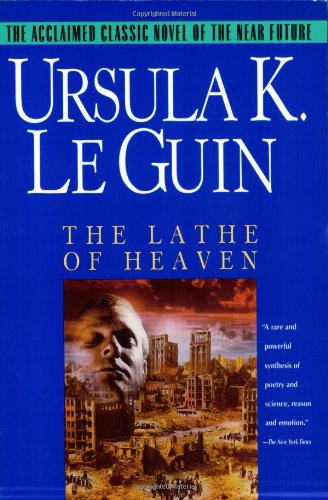
The Lathe of Heaven is a science fiction novel by Ursula K. Le Guin, published in 1971. It won the Locus Award and was adapted for television in 1980 and 2002. Below you will find a part-by-part summary, five key takeaways, ideas worth remembering and a note on who will enjoy it.
Content note: Includes mass death, drug use, disaster and psychological distress.
Main Characters
- George Orr: A gentle man whose dreams change reality.
- Dr. William Haber: An ambitious psychiatrist who uses George's dreams.
- Heather Lelache: A lawyer who helps George.
- The Aliens: Turtle-like visitors who appear in a changed reality.
- The world: A reality that keeps being rewritten.
What Happens, Part by Part (Contains Spoilers)
Effective dreams
George discovers in his teens that some of his dreams, which he calls “effective,” change reality, and everyone except him forgets the old version. Frightened by this power, he takes drugs to stop dreaming. When he is caught, he is ordered to undergo therapy with Dr. Haber, a sleep researcher.
Haber's experiments
Haber uses a machine called the Augmentor to control George's dreams under hypnosis. When he sees that George's dreams change reality, he does not tell George he believes him. Instead, he gives George suggestions to dream about. George dreams of a better office for Haber, and Haber suddenly has one.
Fixing the world
Haber tells George to dream about solving overpopulation, and George dreams a plague that wiped out billions in the past. When Haber asks for peace on Earth, George dreams of an alien attack that unites humanity. Every “fix” causes new disasters, and Haber grows more powerful with each change, now heading a large institute.
Heather
George asks a lawyer, Heather Lelache, to help him. She sees one of his dreams change the world and believes him. They fall in love. In one reality, they marry, but a later change erases her. George struggles to remember and find her. When Haber asks him to dream away racism, everyone becomes gray-skinned, and Heather, who was of mixed race, no longer exists in that form.
Chaos
Haber learns to dream effectively himself using the machine and George's patterns. His dream unravels reality into chaos. George, guided by calm advice from the turtle-like Aliens, finds the machine and turns it off. The world settles into a new, imperfect reality. Haber is left broken. George meets a version of Heather again, and they begin to rebuild a life.
5 Key Takeaways
- Good intentions can lead to disaster.
- Power should be used with humility.
- Trying to control everything can destroy what matters.
- Living in harmony with the world is wiser than forcing change.
- Love can help people find their way back.
Ideas Worth Remembering
These are paraphrased, not direct quotes:
- Not every problem can be fixed by force.
- Some people seek power for the “greater good” at any cost.
- Accepting uncertainty can be a form of wisdom.
Who Should Read The Lathe of Heaven?
Read The Lathe of Heaven if you enjoy short, philosophical science fiction, alternate realities and ideas about power. It suits adults and older teens.
About Ursula K. Le Guin
Ursula K. Le Guin (1929–2018) was an American writer who lived in Portland, Oregon, the setting of The Lathe of Heaven. She was the daughter of the anthropologist Alfred Kroeber. Her books include A Wizard of Earthsea, The Left Hand of Darkness and The Dispossessed. She was known for gentle, thoughtful heroes and for questioning ideas about power.
Questions to Think About After Reading
These prompts work for solo reading, a book club or a classroom discussion of The Lathe of Heaven:
- Is Haber a villain or a misguided idealist?
- Why does George resist changing the world?
- What does the novel say about trying to create a perfect world?
How to Use This Summary
Use this page as a quick reference before a book club meeting, an exam, or a decision about whether The Lathe of Heaven is worth your time. The takeaways are written to stand on their own. If a point interests you, go back to the book for the author's full story, characters and style, which no short summary can replace.
A Note on Accuracy and Spoilers
This summary is based on the published text of The Lathe of Heaven, not on any film, series or stage adaptation, which often change the story. Details are kept at the level of the main events so that nothing is invented. Editions differ slightly in length and wording, so page numbers and small details may vary between copies.
Should You Read the Book?
Yes. It is short, surprising and full of ideas.
Check price of The Lathe of Heaven on Amazon
What to Read Next
- The Dispossessed by Ursula K. Le Guin: another thoughtful Le Guin classic
- Ubik by Philip K. Dick: a story in which reality keeps shifting
- Slaughterhouse-Five by Kurt Vonnegut: a man unstuck in time
Related: The Ones Who Walk Away from Omelas by Ursula K. Le Guin: Summary and Key Takeaways · The Dispossessed by Ursula K. Le Guin: Summary and Key Takeaways
Frequently Asked Questions
What is The Lathe of Heaven about?
A man's dreams change reality, and his psychiatrist uses them to reshape the world.
Who wrote it?
Ursula K. Le Guin, in 1971.
What are effective dreams?
Dreams that change reality.
Who is Haber?
A psychiatrist who uses George's dreams to gain power.
Who is Heather Lelache?
A lawyer who helps George and falls in love with him.
Where is it set?
Portland, Oregon, in the near future.
Are there adaptations?
Yes, a 1980 TV film and a 2002 TV film.
Did it win awards?
Yes, the Locus Award in 1972.
What age is it for?
Adults and older teens.
How long is it?
About 180 pages.
Is it hard to read?
No. It is short and clear, though full of ideas.
Is it part of a series?
No, it is a standalone novel.
Is The Lathe of Heaven a good first Le Guin book?
Yes. It is her shortest major novel and one of her most accessible.
Is The Lathe of Heaven worth reading?
It depends on what you want. The book is best for readers who want a short, mind-bending novel about power, dreams and good intentions. If that describes you, it is likely a good fit. If not, the titles under What to Read Next may suit you better.