
Disclosure: As an Amazon Associate, Bookish Wisdom earns from qualifying purchases. This doesn't change our picks or your price.
TL;DR: In 1963, German journalist Peter Miller reads the diary of a Holocaust survivor who has just taken his own life in Hamburg. The diary describes Eduard Roschmann, the “Butcher of Riga,” who is still alive. Miller sets out to find him, infiltrating ODESSA, a secret organization of former SS members, while Israeli agents and Nazi assassins watch his every move.
Table of Contents
The Odessa File at a Glance
| Author | Frederick Forsyth |
| First published | 1972 |
| Type | Thriller |
| Best for | readers who enjoy historical thrillers with real-world stakes |
The Odessa File is a thriller by Frederick Forsyth, published in 1972. It blends fiction with real history, including the real war criminal Eduard Roschmann. Below you will find a part-by-part summary, five key takeaways, ideas worth remembering and a note on who will enjoy it.
Content note: Includes Holocaust atrocities, suicide and violence.
Main Characters
- Peter Miller: A young German crime reporter.
- Salomon Tauber: A Holocaust survivor whose diary starts the story.
- Eduard Roschmann: A former SS commandant in hiding.
- Sigi: Miller's girlfriend, a dancer.
- Mackensen: An ODESSA assassin sent to kill Miller.
What Happens, Part by Part (Contains Spoilers)
The diary
On the day President Kennedy is shot, Peter Miller follows an ambulance to a death in Hamburg. A detective gives him the diary of Salomon Tauber, who survived the Riga ghetto. The diary describes the cruelty of Captain Eduard Roschmann.
The search
Miller learns that West German authorities are unwilling to pursue Nazi criminals. He discovers that ODESSA, a network of former SS men, protects people like Roschmann with new identities.
Undercover
A group of Jewish avengers trains Miller to pose as a former SS sergeant so he can infiltrate ODESSA. He learns SS slang and history and travels south, but ODESSA suspects him.
Danger
ODESSA sends an assassin, Mackensen, after Miller. Miller learns that Roschmann now runs a factory and is involved in a plan to help Egypt build rockets with guidance systems to attack Israel. A forger's book reveals Roschmann's new identity.
Confrontation
Miller confronts Roschmann at his home. Roschmann shoots him, but Israeli agents save Miller and Roschmann flees. The rocket plan fails. Miller's personal reason is revealed: Roschmann had murdered his father, a German army officer, during the war.
5 Key Takeaways
- The past must be confronted, not hidden.
- Justice for war crimes is often delayed.
- Ordinary people can take on powerful networks.
- Personal motives can drive great courage.
- Governments sometimes protect the guilty.
Ideas Worth Remembering
These are paraphrased, not direct quotes:
- Silence lets criminals escape justice.
- Memory is a form of resistance.
- Truth can hide in a single diary.
Who Should Read The Odessa File?
Read The Odessa File if you enjoy historical thrillers and stories about justice after the Second World War. It suits adults.
About Frederick Forsyth
Frederick Forsyth (1938–2025) was a British author and former foreign correspondent known for thrillers built on careful research. After his success with The Day of the Jackal, he wrote The Odessa File, which drew public attention to the real Eduard Roschmann. His other novels include The Dogs of War and The Fist of God.
Questions to Think About After Reading
These prompts work for solo reading, a book club or a classroom discussion of The Odessa File:
- Why does Miller risk his life?
- What does the novel say about postwar Germany?
- How does the twist about Miller's father change the story?
How to Use This Summary
Use this page as a quick reference before a book club meeting, an exam, or a decision about whether The Odessa File is worth your time. The takeaways are written to stand on their own. If a point interests you, go back to the book for the author's full story, characters and style, which no short summary can replace.
A Note on Accuracy and Spoilers
This summary is based on the published text of The Odessa File, not on any film, series or stage adaptation, which often change the story. Details are kept at the level of the main events so that nothing is invented. Editions differ slightly in length and wording, so page numbers and small details may vary between copies.
Should You Read the Book?
Yes. It is fast, gripping and rooted in real history, though it simplifies some facts for the story.
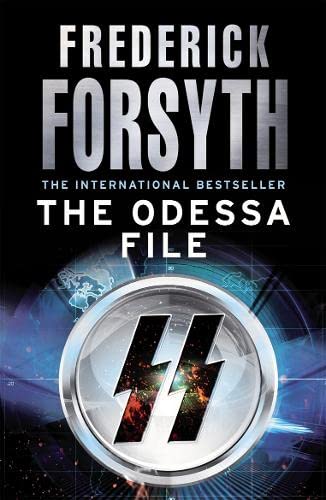
Check price of The Odessa File on Amazon
What to Read Next
- The Day of the Jackal by Frederick Forsyth: Forsyth's classic thriller
- The Boys from Brazil by Ira Levin: Nazis plot in exile
- Marathon Man by William Goldman: a hunted Nazi war criminal
Related: 15 Books Like The Odessa File You’ll Love · The Day of the Jackal by Frederick Forsyth: Summary and Key Takeaways
Frequently Asked Questions
What is The Odessa File about?
A journalist hunts a Nazi war criminal protected by a secret network.
Who wrote it?
Frederick Forsyth, in 1972.
Was Eduard Roschmann real?
Yes, a real SS commandant at the Riga ghetto.
What was ODESSA?
A rumored network that helped former SS members escape justice.
Why does Miller hunt Roschmann?
Roschmann killed his father during the war.
Is there a film?
Yes, the 1974 film with Jon Voight.
What age is it for?
Adults.
How long is it?
About 340 pages.
Did the book affect real events?
It drew attention to Roschmann, who was later identified in South America.
Where is it set?
Mainly in West Germany in 1963–64.
Who are the main characters in The Odessa File?
The main characters are Peter Miller, Salomon Tauber, Eduard Roschmann, Sigi and Mackensen. Peter Miller: A young German crime reporter. Salomon Tauber: A Holocaust survivor whose diary starts the story. Eduard Roschmann: A former SS commandant in hiding.
Is The Odessa File worth reading?
It depends on what you want. The book is best for readers who enjoy historical thrillers with real-world stakes. If that describes you, it is likely a good fit. If not, the titles under What to Read Next may suit you better.