
Disclosure: As an Amazon Associate, Bookish Wisdom earns from qualifying purchases. This doesn’t change our picks or your price.
TL;DR: Your Money or Your Life argues that money is something you trade your life energy for, so every purchase costs hours of your life. Through a nine-step program, Vicki Robin and Joe Dominguez show how to track every dollar, calculate your real hourly wage, find out how much is enough and reach financial independence, the point where investment income covers your expenses.
Note: This summary is for educational purposes and isn’t financial advice.
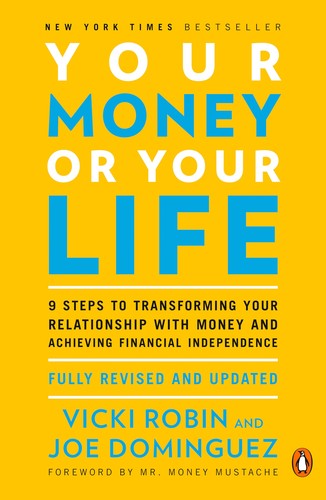
First published in 1992, with revised editions in 2008 and 2018, Your Money or Your Life: 9 Steps to Transforming Your Relationship with Money and Achieving Financial Independence is considered a founding book of the modern FIRE (financial independence, retire early) movement. Joe Dominguez retired from Wall Street at 31 and developed the program; Vicki Robin co-wrote the book and updated it after his death in 1997.
Table of Contents
Your Money or Your Life at a Glance
| Detail | Info |
|---|---|
| Authors | Vicki Robin and Joe Dominguez |
| Published | 1992 (revised 2008 and 2018) |
| Genre | Personal finance / simple living |
| Structure | A nine-step program, one chapter per step |
| Best for | Anyone feeling trapped by work and spending, and readers interested in FIRE |
What Is Your Money or Your Life About?
The authors define money as something we trade our life energy for: the limited hours we have on Earth. Seeing money this way changes how you spend it. The question becomes not can I afford this? but is this worth the hours of my life it costs?
The Nine Steps
Step 1: Make Peace With the Past
Calculate how much money you’ve earned in your lifetime and what you have to show for it, by creating a personal balance sheet of assets and liabilities. The goal is awareness, not shame.
Step 2: Be in the Present: Track Your Life Energy
Calculate your real hourly wage by subtracting work-related costs (commuting, work clothes, decompression spending) from your income and adding the hidden hours work takes. Then track every cent that comes into or goes out of your life.
Step 3: Where Is It All Going?
Each month, categorize your spending and convert each category into hours of life energy using your real hourly wage.
Step 4: Three Questions That Will Transform Your Life
For each category, ask: did I receive fulfillment, satisfaction and value in proportion to the life energy spent? Is this spending aligned with my values? How might this spending change if I didn’t have to work for money?
Step 5: Make Life Energy Visible
Create a wall chart showing your monthly income and expenses over time, so you can see your progress.
Step 6: Value Your Life Energy by Minimizing Spending
Reduce spending that doesn’t bring fulfillment, through mindful choices rather than deprivation.
Step 7: Value Your Life Energy by Maximizing Income
Look for ways to earn more for your life energy and to see work as a choice rather than an obligation.
Step 8: Capital and the Crossover Point
As savings grow, track the monthly income your investments could generate. The crossover point is where that investment income exceeds your monthly expenses. At that point, you’re financially independent.
Step 9: Invest for Long-Term Income
Invest your savings conservatively to produce reliable income. Newer editions update the investing advice to reflect modern options, including low-cost index funds.
The Fulfillment Curve
A central idea is the fulfillment curve: spending on survival brings huge fulfillment, comforts bring a bit more, luxuries bring less, and eventually more spending brings less satisfaction. The peak is enough, the point where you have everything you need and some special extras, without excess.
5 Key Takeaways From Your Money or Your Life
- Money is life energy. Every purchase costs hours of your life.
- Know your real hourly wage. It’s usually far lower than you think.
- Track everything. Awareness alone changes spending.
- Find enough. More spending eventually brings less fulfillment.
- Aim for the crossover point. When investments cover expenses, work becomes optional.
Ideas Worth Remembering
- Money is something we choose to trade our life energy for. (paraphrased)
- Enough is a fixed point, not a moving target, once you define it. (paraphrased)
- Financial independence is having an income sufficient for your needs from a source other than a paid job. (paraphrased)
Who Should Read Your Money or Your Life?
It’s ideal for anyone who feels stuck in a cycle of working and spending, people interested in FIRE or simple living, and couples who want to align money with their values. Readers looking only for investment tips may find it more philosophical than expected.
What to Read Next
- The Simple Path to Wealth by JL Collins on simple index investing.
- Die With Zero by Bill Perkins on spending money on experiences while you can.
- The Psychology of Money by Morgan Housel on behavior and wealth.
Related: The Simple Path to Wealth summary and best books for organizing your life.
Frequently Asked Questions
What are the nine steps in Your Money or Your Life?
Make peace with the past; track your life energy; categorize monthly spending; ask three transformative questions; make life energy visible with a wall chart; minimize spending; maximize income; track capital and the crossover point; and invest for long-term income.
What is life energy in Your Money or Your Life?
Life energy is the limited time and energy you have in your life. Money is something you trade your life energy for, so every purchase costs part of your life.
What is the crossover point?
The crossover point is when the monthly income from your investments exceeds your monthly expenses, making you financially independent.