
Disclosure: As an Amazon Associate, Bookish Wisdom earns from qualifying purchases. This doesn’t change our picks or your price.
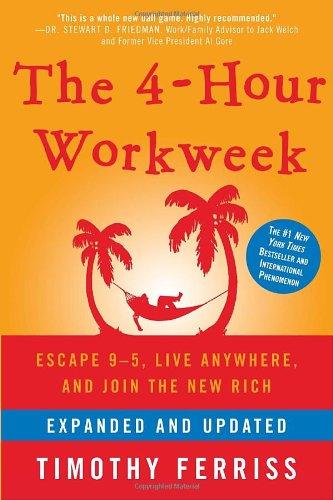
TL;DR: The 4-Hour Workweek: Escape 9-5, Live Anywhere, and Join the New Rich by Timothy Ferriss argues that you can design a life of freedom by focusing on effectiveness, automating income and outsourcing routine tasks. His DEAL framework of Definition, Elimination, Automation and Liberation guides readers from the traditional deferred-life plan to a lifestyle built around time and mobility.
When The 4-Hour Workweek appeared in 2007, it challenged the assumption that you must work hard for forty years and retire at sixty-five to enjoy life. Timothy Ferriss, then a young entrepreneur, described how he built a business that ran with little of his time and used the freedom to travel and learn. The book became a long-running bestseller and helped launch the lifestyle design movement. It’s also criticized for exaggeration and for advice that doesn’t suit everyone. Here’s a summary of its main ideas.
Table of Contents
The 4-Hour Workweek at a Glance
| Detail | Info |
|---|---|
| Author | Timothy Ferriss |
| Published | 2007 (expanded edition in 2009) |
| Genre | Productivity, entrepreneurship, lifestyle |
| Core idea | Design a flexible life by working smarter, not longer |
| Structure | Four steps: Definition, Elimination, Automation, Liberation |
| Best for | Entrepreneurs, remote workers and readers questioning the traditional career path |
What Is The 4-Hour Workweek About?
Ferriss introduces the New Rich, people who prize time and mobility over a large bank balance. They want freedom to live anywhere and pursue interests, instead of postponing life until retirement. He contrasts them with the Deferrers, who save up for decades of work before enjoying life.
His framework, DEAL, is a sequence of steps. Definition resets how you think, Elimination frees up time, Automation sets up income that doesn’t depend on your hours and Liberation removes the need to be in a specific place.
Key Ideas, Part by Part
D Is for Definition
The first step is to question assumptions. Ferriss suggests that being busy is not the same as being productive, and that the goal is effectiveness, doing the right things, not efficiency, doing things well that should not be done at all. He introduces the Pareto principle, or the 80/20 rule, which holds that roughly 80 percent of results come from 20 percent of efforts.
He also describes fear-setting, an exercise in which you write down the worst that could happen if you took a risk, how you could prevent it and how you could repair the damage. Many readers find that doing this makes fears more manageable. Another idea is dreamlining, setting concrete goals and costing them out, so that you know how much income you really need.
E Is for Elimination
The second step is to free up time. Parkinson’s Law says that work expands to fill the time available, so Ferriss recommends setting shorter deadlines. He proposes a low-information diet, cutting news and unnecessary email, and checking messages at set times. He also advises saying no to meetings that lack a clear purpose and to clients who consume resources but add little.
The aim is to focus on the few tasks that matter, and to stop spending time on trivial ones simply because they are urgent.
A Is for Automation
The third step is to build income that does not require constant presence. Ferriss describes outsourcing routine tasks to virtual assistants, including research, scheduling and bookings. He shares tips on writing clear instructions and managing helpers.
He also introduces the muse, a small business designed to run with minimal time. A muse sells a niche product, relies on outsourced fulfillment and is tested cheaply before launch. Ferriss’s own example was a nutritional supplement company. He suggests testing demand with small advertising experiments and focusing on products with high margins.
L Is for Liberation
The final step is to break free from the office. Ferriss offers a method for negotiating remote work: show the employer a trial period, demonstrate results and propose that you work from home part of the time. He describes mini-retirements, extended breaks of a month or more spread through life, as an alternative to saving all your rest for the end.
He also discusses geoarbitrage, earning in a strong currency while living where costs are lower, and the importance of filling your new free time with meaningful activity so that you do not simply replace work with boredom.
6 Key Takeaways From The 4-Hour Workweek
- Optimize for effectiveness. Do fewer, more important things.
- Use the 80/20 rule. Find the few efforts that create most results.
- Limit time on low-value tasks. Shorten deadlines and batch email.
- Delegate and automate. Free yourself from routine work.
- Design the lifestyle first. Define what you want, then work backward.
- Take mini-retirements. Spread rest and adventure across life.
Ideas Worth Remembering
- Being busy is often a form of laziness, avoiding the important work. (paraphrased)
- Time and mobility are forms of wealth. (paraphrased)
- Fear-setting turns vague worry into a plan. (paraphrased)
- You can test a business idea cheaply before committing. (paraphrased)
How to Apply The 4-Hour Workweek in Real Life
- Run the 80/20 analysis. List your tasks and customers, and find the top few that drive results.
- Try fear-setting. Write the worst case, a prevention plan and a repair plan.
- Batch email. Check messages at fixed times only.
- Delegate one task. Hire help for a routine job and document the steps.
- Plan a mini-retirement. Choose a destination and a date, and work backward.
Criticisms and Limits
Critics argue that the book overpromises. Most people cannot reduce their work to a few hours, and many of Ferriss’s strategies depend on starting a business, which carries risk. Some find the tone gimmicky, and several tools and tactics have dated. Others note that outsourcing and geoarbitrage rely on global wage differences, which not everyone is comfortable with.
Even so, the central question remains valuable: what would you do with your time if you were free to choose? The book’s emphasis on priorities, boundaries and experimentation is useful, even if the full lifestyle is out of reach.
The 4-Hour Workweek in One Minute
Don’t wait for retirement to live well. Define the lifestyle you want, eliminate low-value work with the 80/20 rule, automate or outsource what remains and free yourself from fixed locations. Use fear-setting to face risks, shorten deadlines to beat Parkinson’s Law and test business ideas cheaply. Aim for time and mobility as your true wealth.
Is It Really Four Hours?
The title is a promise that the book itself treats as a provocative target. Ferriss says he worked far more than four hours in some periods, especially when building businesses. The underlying idea is to reduce low-value work and make time for what you care about, not to literally work four hours per week. Readers who focus on the lessons about priorities and delegation tend to get more from the book than those who hunt for a shortcut.
Who It Works For
The most direct use is for people who can control their schedules, such as freelancers, consultants and owners of small online businesses. Employees can still apply the lessons about focus, email and saying no, and may negotiate remote days. Parents, teachers and others with fixed schedules may find parts impractical, but ideas such as the 80/20 rule and fear-setting travel well.
Ethical and Practical Cautions
Some of the book’s methods raise questions. Heavily outsourcing work can be unfair to workers if wages and conditions are poor, and aggressive marketing tactics can cross the line into misleading customers. Business rules and technology have also changed since 2007. Check current laws on taxes, contracts and advertising before copying any tactic, and treat the stories as inspiration, not instructions.
A Weekend Experiment to Start
You can test the book’s ideas in a weekend. On Saturday, list your tasks from the past two weeks and mark which ones produced most of your results. Pick three low-value tasks to drop, delegate or shorten. On Sunday, write a fear-setting page for one decision you have been postponing, and set a calendar block for the first small step. Next week, check email only at two set times. At the end of the week, note what changed in your energy and output.
Who Should Read The 4-Hour Workweek?
Read it if you feel stuck in a routine, want to start a side business or are curious about remote work. It suits readers who enjoy practical, energetic writing. If you prefer a calmer view of time, pair it with a book about limits such as Four Thousand Weeks.
What to Read Next
- Essentialism by Greg McKeown the disciplined pursuit of less
- Deep Work by Cal Newport rules for focused success in a distracted world
- Rich Dad Poor Dad by Robert T. Kiyosaki a popular take on money and assets
Related: Deep Work summary and key takeaways and Rich Dad Poor Dad summary and key takeaways.
Frequently Asked Questions
What is the main idea of The 4-Hour Workweek?
That you can design a flexible, free life by focusing on effectiveness, automating income and escaping the traditional work schedule.
What does DEAL stand for?
Definition, Elimination, Automation and Liberation.
Can you really work four hours a week?
For most people not literally; the number is a provocation about reducing low-value work.
What is a mini-retirement?
An extended break of a month or more taken during life, instead of saving all leisure for retirement.
What should I read after it?
Try Deep Work, Essentialism or Four Thousand Weeks.