
Disclosure: As an Amazon Associate, Bookish Wisdom earns from qualifying purchases. This doesn’t change our picks or your price.
TL;DR: Think Again: The Power of Knowing What You Don’t Know by Adam Grant argues that in a fast-changing world, the ability to rethink and unlearn matters as much as the ability to think. Grant explains why we cling to old opinions, how to think like a scientist, how to have productive disagreements and how to build cultures that value learning over certainty.
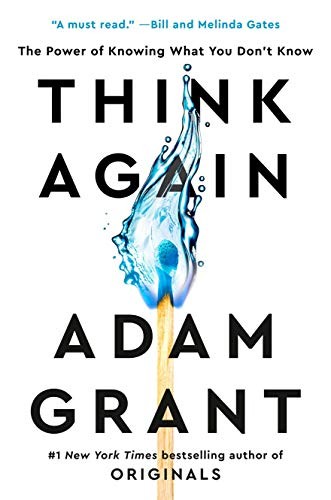
Most of us pride ourselves on our knowledge and convictions. Organizational psychologist Adam Grant, a professor at the Wharton School and author of Originals and Give and Take, says that the more valuable skill is the willingness to question what we believe. Think Again, published in 2021, mixes research from psychology with stories about people who changed their minds, and offers methods for staying open without losing confidence. It’s an easy, engaging read. Here’s a summary of its main ideas.
Table of Contents
Think Again at a Glance
| Detail | Info |
|---|---|
| Author | Adam Grant |
| Published | 2021 |
| Genre | Psychology, decision-making, business |
| Core idea | Rethinking and unlearning are essential skills in a changing world |
| Structure | Three parts: individual, interpersonal and collective rethinking |
| Best for | Leaders, teachers, parents and anyone who wants to disagree better and learn faster |
What Is Think Again About?
Grant begins with the idea that we tend to act as preachers, prosecutors or politicians. A preacher defends sacred beliefs, a prosecutor attacks others’ arguments and a politician campaigns for approval. Each mode protects our identity but limits learning.
He suggests thinking like a scientist: forming hypotheses, running experiments and updating when evidence changes. Scientists hold views loosely, and they find joy in discovering they were wrong because it means they have learned something.
Key Ideas, Part by Part
Individual Rethinking: Doubt and Humility
Grant introduces the idea of confident humility, which means having faith in your ability while doubting your current solution. He contrasts this with arrogance and with impostor syndrome. He also cites the Dunning-Kruger effect, in which people with limited knowledge overestimate their ability, and describes the stages from armchair quarterback, who has strong opinions and little knowledge, to impostor, who has knowledge but low confidence.
He tells the story of Mike Lazaridis, co-founder of BlackBerry, who clung to the physical keyboard even as touchscreens took over, as an example of how success can blind us. He also describes how forecasters in the Good Judgment Project outperformed experts by updating their views often and thinking in probabilities. The lesson is to look for the joy of being wrong, to question your own thinking and to separate your identity from your opinions.
Interpersonal Rethinking: Changing Minds
The second part explores how to help others rethink. Grant discusses argument and says that attacking people’s views often makes them dig in. Instead, he suggests asking open questions, finding common ground and acknowledging what is valid in the other side. He draws on motivational interviewing, a method used in counseling that helps people find their own reasons to change.
He shares examples of negotiators and doctors who changed minds by listening. He also advises complexifying contentious topics, showing that issues have many sides, which can reduce polarization. He discusses how to disagree productively: argue as if you are right, but listen as if you are wrong. He recommends having a challenge network of people who question you, alongside a support network that encourages you.
Collective Rethinking: Schools, Workplaces and Society
The final part considers how groups can foster rethinking. Grant argues that teams benefit from task conflict, disagreements about ideas, but suffer from relationship conflict, personal friction. Leaders can create psychological safety so that people feel free to challenge. He emphasizes the value of process accountability, rewarding good decision processes and not only outcomes.
In education, he encourages teachers to teach students how to think and question and not simply what to think. He also warns about escalation of commitment, the tendency to continue in a failing course of action because of past investment. Organizations can build learning cultures by encouraging experiments, reviewing mistakes without blame and reminding people that updating is a strength, not a weakness.
6 Key Takeaways From Think Again
- Rethinking is a skill. Being willing to unlearn matters as much as learning.
- Think like a scientist. Treat beliefs as hypotheses.
- Aim for confident humility. Be sure of your ability, unsure of your answers.
- Ask, don’t attack. Questions open minds more than arguments.
- Build a challenge network. Seek people who respectfully disagree.
- Reward good processes. Judge decisions by how they were made, not only how they turned out.
Ideas Worth Remembering
- The goal of an argument is to learn, not to win. (paraphrased)
- Your opinions are not your identity. (paraphrased)
- Updating your views is a sign of strength. (paraphrased)
- Knowledge has a half-life, so keep reviewing it. (paraphrased)
How to Apply Think Again in Real Life
- Hold a belief loosely. Write what evidence would change your mind.
- Run a rethinking check. Review one decision every month.
- Ask open questions. Try What would change your mind? in disagreements.
- Create a challenge network. Invite two honest critics to review your work.
- Praise good process. Recognize teammates for sound reasoning even when outcomes vary.
Criticisms and Limits
Critics say that Grant relies heavily on anecdotes and selective studies, and that some of the research he cites has faced replication concerns, as in several areas of social psychology. Others argue that the advice to be open-minded works best when both sides are acting in good faith, and has limits in cases of misinformation or bad actors. Some readers find the book too long for its main idea.
The core message, that the willingness to rethink is valuable, still resonates. Use the tools as prompts for reflection, and weigh them with your own judgment.
Think Again in One Minute
Don’t just think; rethink. Replace preacher, prosecutor and politician modes with a scientist’s curiosity. Combine confidence in your ability with humility about your answers. Ask open questions, find common ground and surround yourself with a challenge network. Reward good decision processes, and build cultures where changing your mind is welcome.
Motivational Interviewing in Plain Terms
Motivational interviewing is a counseling style in which the helper asks open questions, listens, reflects back what they hear and invites the person to talk about their own reasons for change. Instead of telling someone what to do, you help them explore their ambivalence. Grant argues that the approach works in many contexts, from health care to workplace feedback, because people are more likely to act on ideas they come to themselves.
The Role of Identity
Grant points out that we often cling to opinions because they feel like part of who we are. Separating identity from belief is hard but powerful. He suggests defining yourself by values, such as curiosity and honesty, instead of fixed positions. Then changing your view becomes consistent with your values. This helps especially in polarized debates, where updating can feel like betrayal of a tribe.
Rethinking in Daily Life
The ideas apply at home and work. Parents can ask teens why they hold a view and listen before responding. Managers can run pre-mortems, imagining a project failed and listing the reasons, to expose blind spots. Students can test their understanding by teaching others. Even small acts, such as saying I might be wrong, help create a culture where learning is normal. Practice with low-stakes questions before tackling charged topics.
A Weekly Rethinking Habit
Set aside fifteen minutes each week to review a belief, a plan or a decision. Ask: What evidence supports this? What evidence would change my mind? Who disagrees with me, and what might they see that I do not? What would I advise a friend in my position? Write brief answers and decide whether to hold, adjust or drop the view. Over time, the habit builds the flexibility Grant describes and makes disagreement feel less threatening.
Pre-Mortems and Learning Cultures
One practical tool is the pre-mortem. Before launching a project, the team imagines that it has failed a year later and writes down reasons. This exposes risks that optimism hides. Pair it with a post-mortem afterward to learn from outcomes without blame. Grant argues that organizations that normalize such reviews make it safer to change course, which helps them adapt when markets and technology shift.
Who Should Read Think Again?
Read it if you lead teams, teach, parent or simply want to argue better and learn faster. It suits readers who like psychology with stories. For more on decision-making, pair it with Thinking, Fast and Slow.
What to Read Next
- Thinking, Fast and Slow by Daniel Kahneman the science of judgment and decision-making
- Originals by Adam Grant how non-conformists move the world
- Superforecasting by Philip E. Tetlock and Dan Gardner the art and science of prediction
Related: Thinking, Fast and Slow summary and key takeaways and Grit summary and key takeaways.
Frequently Asked Questions
What is the main idea of Think Again?
That the ability to rethink and unlearn is as important as the ability to think, and that we should approach beliefs like scientists.
What is confident humility?
Having faith in your capability while doubting your current solution or opinion.
What are preacher, prosecutor and politician modes?
Defensive mindsets that protect beliefs, attack others’ views or seek approval, instead of seeking truth.
What is a challenge network?
A group of people who respectfully question your ideas, separate from your support network.
Is Think Again good for leaders?
Yes, it offers practical tools for learning cultures and productive disagreement.