
Disclosure: As an Amazon Associate, Bookish Wisdom earns from qualifying purchases. This doesn’t change our picks or your price.
TL;DR: Thinking, Fast and Slow by Daniel Kahneman explains that the mind runs on two systems: a fast, intuitive System 1 and a slow, deliberate System 2. System 1 is usually right but prone to predictable biases. Kahneman shows how these biases shape judgments about risk, money, happiness and memory, and how to catch them.
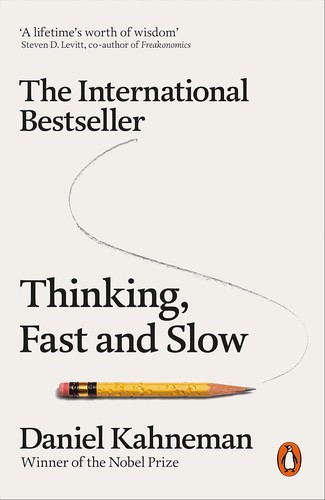
Thinking, Fast and Slow is the culmination of decades of research by Daniel Kahneman, a psychologist who won the 2002 Nobel Prize in Economic Sciences for his work with Amos Tversky on judgment and decision-making. Published in 2011, it presents their findings in a way that general readers can follow, with experiments you can try on yourself. It is long, around 500 pages, and rich, so a summary can serve as a map. Here are the main ideas, grouped by the book’s five parts.
Table of Contents
Thinking, Fast and Slow at a Glance
| Detail | Info |
|---|---|
| Author | Daniel Kahneman |
| Published | 2011 |
| Genre | Psychology, behavioral economics |
| Core idea | Two systems of thinking and the biases they produce |
| Structure | Five parts and thirty-eight chapters |
| Best for | Readers who want to understand decision-making, bias and risk |
What Is Thinking, Fast and Slow About?
Kahneman introduces two characters: System 1, which operates automatically and quickly with little effort, and System 2, which allocates attention to effortful mental activities such as complex calculations. System 1 generates impressions and feelings, and System 2 often endorses them without checking. The book is about the interaction between the two, and the ways System 1’s shortcuts, called heuristics, lead to systematic errors, called biases.
He stresses that these are labels for convenience, not literal parts of the brain. The main message is humility: even experts, including Kahneman himself, fall for these illusions, and the best defense is to recognize situations where mistakes are likely and slow down.
Key Ideas, Part by Part
Part One: Two Systems
The opening chapters describe the difference between fast and slow thinking, with tests such as the bat-and-ball puzzle, in which many people answer quickly and incorrectly. Kahneman explains that System 2 is lazy, and that cognitive ease, a feeling of familiarity, makes us trust information more. He also introduces WYSIATI, or what you see is all there is: System 1 builds the best story from available information and ignores what’s missing.
Part Two: Heuristics and Biases
Here Kahneman describes mental shortcuts. Anchoring means that an initial number affects later estimates, even if it’s random. Availability means that we judge the frequency of events by how easily examples come to mind. Representativeness means that we judge probability by similarity to a stereotype, as in the Linda problem, in which people think a woman described as outspoken and concerned with social justice is more likely to be a feminist bank teller than a bank teller. Each shows how intuition can ignore statistics.
Parts Three and Four: Overconfidence and Choices
Part Three explores overconfidence: the illusion of understanding the past, the illusion of validity in predictions and the planning fallacy, in which we underestimate how long projects will take. Kahneman argues that experts in unpredictable fields, such as stock picking, often do no better than chance, though they feel certain.
Part Four covers prospect theory, which he developed with Tversky. People evaluate outcomes relative to a reference point, and losses loom larger than equal gains, a pattern called loss aversion. This explains the endowment effect, in which we value what we own more highly, and framing effects, in which the same choice described differently leads to different decisions.
Part Five: Two Selves
The final part distinguishes the experiencing self, which lives through moments, from the remembering self, which keeps score and makes decisions. Our memories of experiences are shaped by their peak and their end, not their duration, a pattern called the peak-end rule. Kahneman illustrates this with a study of patients undergoing a painful procedure, where adding a milder ending made the memory less negative, though the total pain was greater.
He concludes with reflections on well-being, noting that the way we remember life shapes our judgments of happiness, and encourages readers to be aware of the difference between what we experience and what we remember.
7 Key Takeaways From Thinking, Fast and Slow
- Two systems of thought. Fast intuition is useful but error-prone; slow reasoning takes effort.
- What you see is all there is. We form stories from limited information.
- Biases are predictable. Anchoring, availability and representativeness shape judgments.
- Overconfidence is common. We overestimate our knowledge and predictive power.
- Losses hurt more than gains. Loss aversion shapes risk and choice.
- Framing changes decisions. The same facts can lead to different choices.
- We remember differently than we live. Peak and end shape memories.
Ideas Worth Remembering
- Whatever you are focused on feels more important than it really is. (paraphrased)
- We tend to overestimate how well we understand the world and the past. (paraphrased)
- Repeating a claim often makes people more likely to believe it, true or not. (paraphrased)
- How confident someone feels says little about how good their evidence is. (paraphrased)
How to Apply Thinking, Fast and Slow in Real Life
- Slow down for big decisions. Pause and ask what you might be missing.
- Use checklists. Write down criteria before evaluating options.
- Check base rates. Ask how often something like this happens in general.
- Plan with a buffer. Add extra time and budget to counter the planning fallacy.
- Reframe choices. Look at a decision in terms of both gains and losses.
Criticisms and Limits
Kahneman himself noted that parts of the book rely on research that has since been questioned, especially in social priming. Others say that the focus on errors makes people seem more irrational than they are in natural settings, where intuition can be remarkably accurate. The book is also long, and some readers find its examples repetitive.
Still, its core frameworks, such as loss aversion, anchoring and the planning fallacy, continue to influence economics, medicine, law and public policy.
Key Experiments in the Book
Kahneman describes many experiments readers can try. In the anchoring study, people spun a wheel of fortune rigged to land on 10 or 65 and then estimated the percentage of African countries in the United Nations; those who saw the higher number gave higher estimates. In the Linda problem, most people say that Linda is more likely to be a bank teller who is active in the feminist movement than just a bank teller, violating basic probability. The cold-hand experiment tests the peak-end rule. These studies make abstract ideas concrete.
The Partnership Behind the Book
Kahneman dedicates the book in part to his late collaborator Amos Tversky, with whom he worked for about two decades. Their papers on heuristics and prospect theory changed psychology and economics, and Kahneman says that he did not win the Nobel Prize alone, since Tversky died in 1996 and the prize is not awarded posthumously. Michael Lewis’s The Undoing Project tells their story, and reading it alongside the book helps show how science grows from friendship and argument.
Criticisms and Replication Issues
Since the book was published, some of the studies Kahneman cites, especially in the area of priming, have not replicated well, and he acknowledged this, writing that he placed too much faith in small studies. Other critics say the two-systems model is a simplification, and that biases may not always be errors in real-world settings. Kahneman remains an influential figure, and most core findings, such as loss aversion and anchoring, are widely supported, but it’s wise to read the book with some caution.
How to Read This Long Book
Thinking, Fast and Slow is dense, and many readers do best by reading a few chapters at a time. Start with Part One, which gives the basic framework, then pick chapters on topics that interest you. The chapter summaries at the ends of sections and the speaking-of lists, which offer examples of how to use the vocabulary in everyday conversation, are especially helpful. Try the experiments on friends. The book rewards rereading, and the audiobook is a good alternative for commutes.
A Cheat Sheet of Key Terms
A short glossary helps with the book’s vocabulary. Heuristic means a mental shortcut. Bias means a systematic error in judgment. Anchoring means being swayed by an initial number. Availability means judging likelihood by how easily examples come to mind. Base rate means how common something is in general. Loss aversion means losses feel stronger than gains. Framing means that the way a choice is presented changes decisions. The planning fallacy means underestimating time and cost. The peak-end rule means we judge experiences by their high point and ending. Knowing these terms helps you spot the patterns in daily life.
Discussion Questions
To bring the ideas to life, discuss: When did you last make a quick judgment that turned out wrong? Which biases do you notice most in your workplace or family? How might you slow down on big decisions? Do you agree that experts are often overconfident? How does the difference between your experiencing and remembering self change how you plan holidays or events? Writing short answers, or testing a few of the book’s puzzles on friends, makes the ideas stick far better than rereading.
Who Should Read Thinking, Fast and Slow?
Read it if you’re curious about how the mind works, if you make high-stakes decisions or if you enjoy psychology, economics and science writing. It’s a good fit for managers, investors, doctors and anyone who wants to spot errors in reasoning. If it feels too heavy, start with a shorter book such as Predictably Irrational or Nudge, then return to Kahneman.
What to Read Next
- Noise by Daniel Kahneman a follow-up on random variability in judgment
- The Undoing Project by Michael Lewis the story of Kahneman and Tversky’s friendship
- Thinking in Bets by Annie Duke a practical guide to decision-making under uncertainty
Related: books like Thinking, Fast and Slow and Predictably Irrational summary and key takeaways.
Frequently Asked Questions
What is the main idea of Thinking, Fast and Slow?
That our minds use a fast, intuitive system and a slow, deliberate system, and that the first produces predictable biases.
What are System 1 and System 2?
System 1 is fast, automatic thinking; System 2 is slow, effortful thinking.
What is loss aversion?
The tendency for losses to feel stronger than equal gains.
Is Thinking, Fast and Slow hard to read?
It’s long and sometimes dense, but the examples are engaging.
What should I read after Thinking, Fast and Slow?
Try Noise, The Undoing Project or Thinking in Bets.